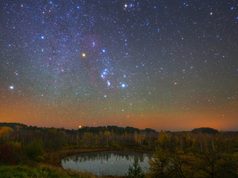















































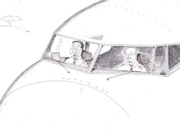

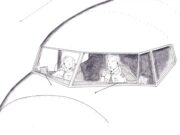




In the northern hemisphere, fall is one of the best times of the year for astronomers. The lighter nights of summer are now behind us and following the autumnal equinox (equal day and night) on 22 September, the nights are becoming longer. The fall constellations are rising in the east and are followed by the bright winter constellations around midnight.
As you observe the night sky, possibly from the flight deck of an aircraft in October through to December, it is the best time of the year to see the Milky Way as it stretches right across the sky from the southwestern to the northeastern horizon. To see the Milky Way, you need to have minimal lighting in the cockpit to enable your eyes to get used to the dark. Try to spot a band of faint mist/stars in the sky from 225o to 450o. To ancient observers, it looked like a patch of milk had been stretched out across the sky, hence the origin of the name Milky Way. According to ancient mythology, a wet nurse in the heavens was suckling a baby and the child bit her. In anger, the woman threw the baby across the sky and milk spilt from the child’s mouth. Today we see this as the Milky Way, our home galaxy.
A few years ago, during a beautiful clear night, we held a public stargazing event, and I was in the process of pointing out various features of the night sky when a lady came up to me and commented, “What a wonderful night, but what a shame about that patch of cloud overhead.”
“Well,” I said, “That patch of cloud is in fact our own galaxy––The Milky Way!”




As the sun sets in the west, it is possible to see the three bright stars of the summer triangle moving toward the western horizon. The three stars that make up the triangle (Deneb in the constellation Cygnus, Vega in Lyra, and Altair in Aquila) are easily seen as the first stars visible as the sky darkens each evening. Once the sky is fully dark, the sky is dominated by the fall stars, noticeably the constellations Andromeda, Pegasus and Perseus. Andromeda has within it the magnificent Andromeda Galaxy (M31). All the stars visible to the naked eye are all within our Milky Way. However, the Andromeda Galaxy is another that is just about visible to the naked eye. If you can see it, you have great eyesight, as it is an astonishing 2.5 million light-years away. That means that the light your eyes are observing was generated by the stars of Andromeda about 2.5 million light-years ago! To find this, visible as a faint, diffuse object to the naked eye, use the chart below. If you have a pair on the flight deck, a small pair of binoculars will show it more clearly.
Until 1923, we believed that the universe comprised just one galaxy––The Milky Way. Edwin Hubble, working at the Mount Wilson observatory in California, using the period-luminosity relationship which had been discovered by Henrietta Leavitt a few years earlier, realised that stars in the Andromeda Galaxy were much further away, and therefore part of another galaxy. This was to give rise to the expanding universe or The Big Bang theory. We now believe there are as many galaxies as there are grains of sand on the beaches of our planet!
In fall and winter there are a few meteor showers visible. The Draconids peak on and around 7 October and untypically appear at their best before midnight. From the flight deck, if you look towards the northern horizon you may see about ten meteors in an hour. Another shower that peaks in October is the Orionid shower which appears to radiate from the constellation of Orion. The Orionids peaks on and around 21 October, and as the Moon will not be rising until well after midnight, there is good chance to see some bright and fast meteors in the eastern sky around midnight. The Orionid meteors often leave trails behind them that last a bit longer than other meteors, so it is well worth a look. The Taurid and Leonid showers both peak in November but are not normally very prolific. The Geminids however, on and around December 12, are one of the best of the year.
In the evening sky, the planet Saturn is visible in the evening sky in the constellation of Pisces, below the square of Pegasus. Saturn went through ‘opposition” on 21 September, which means it was due south at midnight, directly in the opposite direction to the Sun. Unfortunately, as seen from the Earth we went through what is known as a “ring plane crossing” earlier this year, which means that the magnificent ring system is to our edge making it difficult to see.
In the morning sky, Venus, following last month’s “eastern elongation” (furthest angular distance from the Sun) is now slowly heading towards and behind the Sun (superior conjunction) next January. The bright Jupiter is also easily spotted in the dawn sky above the brighter Venus in the winter constellation of Gemini.
The Fall sky – October to December
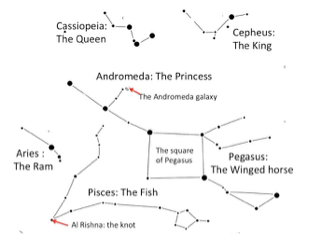

The Andromeda Galaxy (M31)
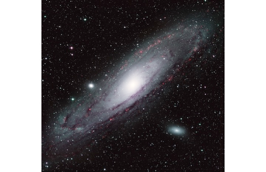
The furthest object seen by the naked eye