




















































One of the questions I’m regularly asked is, “How often should we look at our compensation levels?” At the risk of sounding like an attorney, my answer to that question is, “It depends.” But the good news is that there are only two main factors to consider:
- The market for the job skills of the person(s) under review: has the demand increased, decreased, or remained constant? Are these people in high demand? If they are, market compensation levels will rise more quickly, and company levels will need to be reviewed more frequently.
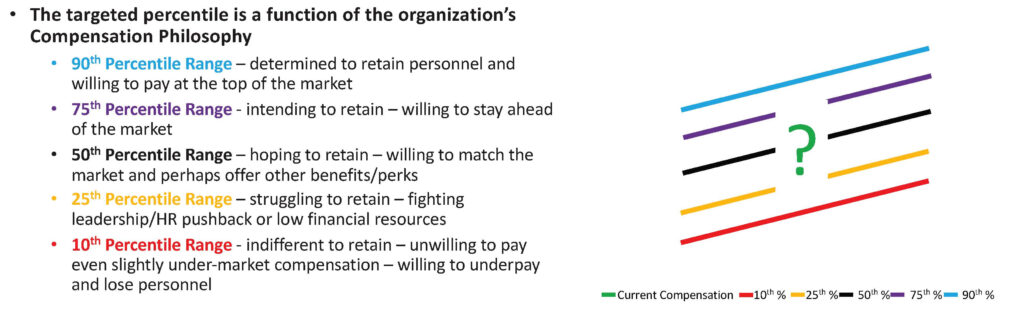
- What is the company’s compensation philosophy regarding targeted-pay percentiles? A company targeting the 50th percentile will get behind the market more quickly than a company targeting a percentile above that. Refer to the figure below for my perspective on percentile targets versus company intent.
Most companies I work with incorporate a compensation review into their annual personnel review process, and some link it to their annual budget process. In either case, the review occurs at least once per year, which, in my opinion, should be the minimum interval. However, even if a company adheres to an annual process for formal compensation reviews, I would argue that it is in the aviation manager’s best interest to stay informed about compensation levels on a more frequent basis, at least semiannually. Now, I’m not advocating for formal compensation reviews multiple times per year, but I am saying that managers need to be aware of what compensation levels are doing, particularly for the positions that are more in demand.
One of the reasons I regularly refresh the AirComp Calculator’s database is so that aviation managers/professionals can review the same positions multiple times throughout the year to observe the rate of change in compensation. However, even if the aviation manager doesn’t use my tool, they can still stay engaged with their colleagues in the industry and remain informed about industry news that discusses compensation. The payoff for this kind of engagement is twofold. First, the aviation manager can better advocate for their people when the formal annual review process occurs. Second, they can prepare their superiors for what is to come throughout the year so that when the formal review occurs, there is less shock and surprise and more cooperation to resolve gaps between current compensation levels and those of the market.
Realistic Merit Increases



The first thing to understand here is that merit increases and market-driven increases are not the same. In fact, there are five categories of base pay adjustments:
- Merit Increase – Yearly increases given to employees based on company performance and compensation philosophy
- Cost-of-living adjustments (COLAs) – Payments made to allow employees to keep pace with the rate of inflation
- It is quite common to confound inflation/cost of living with cost of labor, but cost of labor is what compensation surveys measure and what governs pay practices.
- Cost of living can drive cost of labor, but the two indices do not always correlate.
- Equity Adjustments – Pay adjustments made to pay grades when compression issues occur between superiors and subordinates or peers with dissimilar lengths of service
- Compression occurs when pay ranges get too close together and/or have too much overlap.
- General Increases a.k.a. Market-Driven Increases – Occur when the organization finds itself behind the market rate for certain positions
- Happens when compensation increases rapidly for positions with “hot jobs”
- Increases can sometimes result in the employee reaching the top of a pay band and rendering the company unable to raise compensation without promoting the employee or changing the pay structure.
- Lump-Sum Payment – Used when the situation described above occurs
- Provided instead of a percentage increase, these payments are made annually to bring an employee’s base pay into a competitive range without exceeding the upper level of an employee’s current pay band.
This matters because the odds are high that you won’t be able to keep up with the market using merit increases alone. We don’t have the space here to map out all the individual positions in a typical flight department, but the table below compares the average compensation raise for the fourteen positions I track, versus the annual rise in compensation for private companies since 2020, according to the US. Bureau of Labor Statistics (BLS). The black line represents the BLS statistic, and the green line represents the rise in business aviation. (Note that the 2025 value for business aviation is a predicted one.) Think of the BLS line as the average of all of the merit increases in the private sector. You can see that while the two indices have been close on occasion, but since 2023, the business aviation rise has outpaced the BLS statistic significantly.
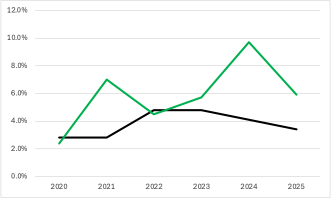
According to WorldatWork, the budgeted increase for 2025 in the private sector is expected to range between 3.5% and 3.9%, which is still significantly lower than the predicted rise in business aviation compensation of nearly 6%. And you’ll have some hot jobs in that grouping for which the compensation will have risen ten percent or more over the course of the year.
So, for all aviation managers, stay engaged with compensation levels throughout the year to anticipate where your challenges will arise before they occur. And don’t let your Human Resources Department convince you that a merit increase is a sufficient raise for your personnel when the data say otherwise.