




















































You've heard it said a thousand times, “Losing weight isn't hard, just eat less and move more.” This is a fundamental of sustainable weight loss. It's not wrong. But what happens when it isn't enough?
I know the person reading this doesn't have a 9-to-5. You travel every week. You eat out not because you're lazy but because you have to. You sleep in a different bed twelve to fifteen nights a month. Your schedule is in constant chaos. Eating less and moving more may not always be a consistent option.
You’re not lazy. Lazy people wash out of this industry fast. It takes discipline to get into a flight deck and it takes discipline to stay there.
The missing variable in crew member weight loss usually isn't effort. Sometimes it's too much effort aimed at the wrong thing — because the standard advice doesn't account for the variables that age us faster than the average fitness client.



So today let’s explore why, “Just eat less,” may not solve your weight-loss problem, and why in some cases it can make it worse.
The deficit doesn't work in a vacuum
You've got myfitnesspal®, or Lose It!®, or one of the other calorie counters. You followed it for a few weeks, maybe a couple of months, and you lost weight. Congratulations — the laws of thermodynamics are still in effect. Then something happened. Either you stopped tracking, or you noticed the same number of calories stopped producing the same results. Same effort, less return.
That brings us to the first thing worth understanding: the way your body uses calories is not fixed. It adjusts. That's a good thing — it's the reason our species survived famine — but it makes for a frustrating fight when you're trying to lose fat. Your body does not care that you want a smaller waist. It cares about keeping you alive. So, when you respond to a stall by feeding it less, and less, and less, you're not overpowering the system. You're triggering it.
What happens to your thyroid
Here's the mechanism, because this gets thrown around loosely and it's worth being precise. Your thyroid mostly produces T4, which is essentially a storage hormone — it doesn't do much on its own. Your body converts T4 into T3, the active form that enters cells and sets your metabolic rate. There's a third player: reverse T3, an inactive mirror image that occupies the same receptors without doing the work. Think of T3 as the crew flying the trip, and reverse T3 as a deadheading crew occupying the seats.
Under stress (caloric restriction is a stressor), your body shifts that conversion away from T3 and toward reverse T3. This isn't merely a theory. In a study published in the Journal of Clinical Endocrinology & Metabolism, researchers found that total fasting produced a 53% reduction in serum T3 alongside a reciprocal 58% increase in reverse T3. And here's the part worth underlining for our audience: in that same study, subjects eating diets containing at least 50 grams of carbohydrate showed no significant change in either T3 or reverse T3. The fuel available mattered — not just the total.
You might be thinking that's starvation-level restriction, and you'd be right. But more recent work found that just five days of moderate caloric deficiency was associated with lower TSH (thyroid-stimulating hormone tells your thyroid gland how much energy-regulating hormone to produce), lower total T3, and an increase in reverse T3.
Five days — that's a four-day trip and the commute home! So, the pilot who responds to a stalled scale by eating less, while sleeping badly on the road, is often manufacturing the exact metabolic slowdown that's about to derail the next three months.
Then there's sleep
Circadian misalignment is a serious obstacle with or without a caloric deficit. Sleeping poorly at irregular hours affects nearly every metabolic lever you have — and for good reason. Your body is trying to keep you functional through something it reads as a threat.
The research here is not ambiguous. Sleep curtailment in healthy young men has been associated with decreased leptin, elevated ghrelin, and increased hunger and appetite. Those are your satiety and hunger hormones, moving in opposite directions, both toward eat more. That 3 p.m. decision in front of the Cinnabon® isn't a character test. It's two hormones doing exactly what they were told to do.
One week of sleep restriction has been shown to reduce insulin sensitivity in healthy men. And in the study I'd point to above all others, researchers restricted subjects to 4.5 hours in bed versus 8.5 hours for four days — under controlled conditions of caloric intake and physical activity — and found impaired insulin signaling in fat tissue. Read that again. Calories held constant. Activity held constant. Insulin sensitivity dropped anyway.
That single study design is the entire argument. If “eat less, move more” were the complete equation, holding both sides constant should hold the outcome constant. It doesn't. On the circadian side specifically, researchers using a forced desynchrony protocol found that misalignment between the body clock and the sleep-wake schedule increased post-meal glucose and insulin responses — reduced glucose tolerance from the misalignment itself, independent of what was eaten. That's not a description of a lifestyle choice. That's a description of a bid line.
Your body triages
Here's the frame that helps most of my clients. If a building were on fire, would it matter that you'd planned to renovate the break room that week? Of course not. You would deal with the fire. Your body agrees. Fat loss and muscle gain are renovation projects. They happen when things are going reasonably well internally. When insulin signaling is impaired, when the thyroid conversion has downshifted, when cortisol is elevated at the wrong end of the day — your waistline is not the priority. Staying alive is — once again, for good reason.
To be clear: this is not an excuse
I want to head something off, because in your seat, I'd be thinking it. None of this is permission to stop trying. It isn't a note from the doctor. Energy balance is real, protein still matters, steps still matter, and nobody has ever gotten leaner by ignoring what they eat. What this is, is a reason to measure before you cut.
If you've already done four rounds of eating less and each one worked a little worse than the last, the next round of eating less is not the answer. First, you need to know what's actually happening inside.
What I recommend instead
A functional approach is to understand how your body is producing energy before you take energy away from it. In our coaching practice, when we run labs on crew members, we commonly see patterns in insulin, liver markers, and hormones. All of these limit how far “eat less, move more” can take someone. Can you lose weight with those markers out of range? Sure. Will it hold? Usually not. The body doesn't want to struggle. It wants to run well. When it doesn't have what it needs to run well, we tend to see it at the waistline — and it isn't simply overeating.
What to do Monday
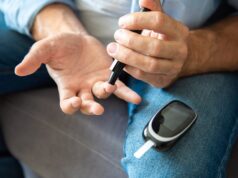
Here's the most useful hundred dollars you can spend on your health this year: buy an over-the-counter continuous glucose monitor (CGM) and wear it for a few weeks. Until 2024 these required a prescription. They no longer do. As of now, there are two available over the counter in the U.S. — Dexcom's Stelo and Abbott's Lingo. Both run roughly $89 to $99 a month, both are HSA and FSA eligible, and Lingo sells a single starter sensor for around $49 if you want to try it before committing. A small sensor goes on the back of your arm and streams your glucose to your phone — no fingersticks, no doctor's visit. One caveat: these are cleared for adults who don't use insulin. If you're insulin-dependent or prone to hypoglycemia, you need a prescription device with alarms. Talk to your physician.
Here's why this is the right first move rather than another diet. A CGM gives you a window into how your metabolism is actually functioning, in your real life, on your real schedule. Not a snapshot from a lab draw at 8 a.m. after a good night's sleep at home, but actual measurements. How does it look on day three of a four-day, at the hotel, after the food you actually ate?
Run the experiments yourself:
- Eat the same meal twice, once with the carbohydrate first and once with the protein first. Watch the difference.
- Eat an identical breakfast after a good night at home and after a short overnight. Watch what changed when nothing about the food did.
- Take a ten-minute walk after dinner one night and skip it the next.
- Watch what happens to your overnight numbers after two drinks on a layover.
You will learn more about your own metabolism in three weeks of that than in three years of tracking calories.
And you don't need to wear one forever. Run a two-to-four-week audit, learn your patterns, and stop. If something you see concerns you, that's the moment to ask your physician to add fasting insulin to your next panel — not just glucose, and not just A1c. Fasting insulin rises years before glucose does, which is exactly why a standard physical can come back clean while you feel like something's off. Good information regardless. No pressure. Just data.
Scott Darragh is a Boeing 737 Captain and the founder of Jet Set Trainer, a metabolic health coaching company for pilots, flight crew, and frequent travelers. He holds NASM-CPT and CNC certifications.
References
- Spaulding SW, Chopra IJ, Sherwin RS, Lyall SS. Effect of caloric restriction and dietary composition on serum T3 and reverse T3 in man. J Clin Endocrinol Metab. 1976;42(1):197.
- Thyroid axis adaptations to moderate short-term energy restriction in healthy, young women. J Clin Endocrinol Metab. 2025.
- Spiegel K, Tasali E, Penev P, Van Cauter E. Brief communication: Sleep curtailment in healthy young men is associated with decreased leptin levels, elevated ghrelin levels, and increased hunger and appetite. Ann Intern Med. 2004;141:846-850.
- Buxton OM, Pavlova M, Reid EW, Wang W, Simonson DC, Adler GK. Sleep restriction for 1 week reduces insulin sensitivity in healthy men. Diabetes. 2010;59(9):2126-2133.
- Broussard JL, Ehrmann DA, Van Cauter E, Tasali E, Brady MJ. Impaired insulin signaling in human adipocytes after experimental sleep restriction: a randomized, crossover study. Ann Intern Med.2012;157(8):549-557.
- Scheer FAJL, Hilton MF, Mantzoros CS, Shea SA. Adverse metabolic and cardiovascular consequences of circadian misalignment. Proc Natl Acad Sci USA. 2009;106:4453-4458.
Educational content. Not medical advice, diagnosis, or treatment.