









































Every pilot reading this has a scan flow. You check engine instruments you fully expect to be normal — not because you think something's wrong, but because that's how you catch a trend before it becomes a problem. TGT creeping up over a few legs doesn't trigger a caution light. You catch it because you were looking.
Now ask yourself: when was the last time you scanned your blood sugar?
If your answer is “never — I'm not diabetic,” you've just described flying without ever looking at a gauge because the master caution hasn't illuminated yet. That's not how we operate an aircraft, and it shouldn't be how we operate the body that flies it.
Blood sugar is a crew problem, not a diabetic problem




Glucose is your body's primary fuel-scheduling system. Every crew member runs on it, and the way we live — red-eyes, three-leg days, hotel breakfasts at 0430, dinner at 2200 because that's when you finally got to the layover — puts unusual stress on that system.
Research of shift workers and circadian disruption has consistently shown that eating and sleeping out of sync with your body clock changes how efficiently you process glucose. The same meal eaten at 8 a.m. and at midnight does not produce the same blood sugar response. Crew members essentially live in a rolling experiment on this, trip after trip, for an entire career.
Here's the part that matters even if your annual bloodwork looks “fine”: glucose regulation doesn't fail overnight. It drifts. Fasting glucose can sit in the normal range for years while post-meal spikes get taller and recovery gets slower. By the time a single fasting number at your physical looks off, the trend has usually been developing for a long time — quietly, with no caution light.
That drift shows up in your daily life before it ever shows up in your chart:
- The 2 p.m. flameout — That leg-three energy crash isn't just fatigue. Large glucose spikes are typically followed by sharp drops, and the drop is what you feel — brain fog, irritability, the overwhelming urge for coffee and a cookie from the galley.
- Hunger that doesn't make sense — Eating a big meal and feeling hungry two hours later is often a blood sugar rebound, not a willpower failure.
- Stubborn midsection weight — Chronically elevated glucose keeps insulin elevated, and elevated insulin is a storage signal. You can be doing “everything right” in the gym and still fight this if your fuel scheduling is chaotic.
- Poor sleep on layovers — Blood-sugar swings overnight are one of several factors that can fragment sleep — and fragmented sleep worsens next-day glucose control. It's a self-reinforcing loop, and crew schedules pour fuel on it.
What “tracking time to time” actually looks like
You don't need to become a data hermit. You need a periodic scan — the same philosophy as a trend check.
Level 1 — Know your annual numbers. At your next physical, don't just accept “labs look good.” Ask for your actual fasting glucose and, if it's drawn, your A1c (a rough three-month average of blood sugar). Write them down. A single number in the normal range tells you little; the same number trending upward year over year tells you a lot. You are the keeper of your own trend data — no one else is tracking it for you.
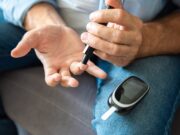
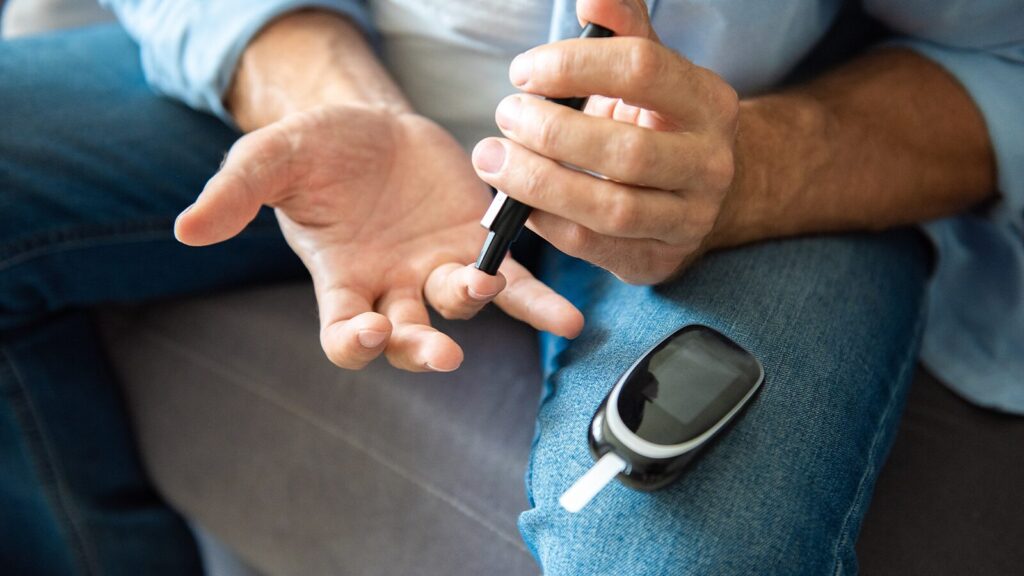
Level 2 — Spot checks. An inexpensive glucometer from any pharmacy lets you check a fasting reading a few mornings in a row; or see what a specific meal does to you 60–90 minutes later. A handful of readings during a normal week — and, more interestingly, during a rough trip — will teach you more about your own body than a year of guessing.
Level 3 — A short, continuous glucose-monitor (CGM) experiment. CGMs are now available over the counter without a prescription. Wearing one for two weeks — ideally spanning a trip and your days off — is like pulling the flight data recorder on your own metabolism. You'll see exactly what the hotel breakfast does, what a red-eye does, what eating your last meal earlier does. Most crew members who try this tell me the same thing: two weeks of data changed their habits more than ten years of advice.
To be clear about my lane: none of this is diagnostic, and a weird reading is a conversation to have with your physician or AME — not a reason to panic, and definitely not a reason to self-treat. What tracking gives you is awareness and trend data, which is exactly what it gives you in the cockpit.
Three schedule-proof moves while you gather data
- Anchor protein at every meal, especially breakfast. Protein blunts the glucose spike from whatever else is on the plate. The hotel breakfast move is eggs first, pastry optional — not the reverse.
- Walk after you eat. Ten to fifteen minutes of walking after a meal measurably reduces the post-meal glucose rise. On a layover, that's one lap around the hotel block. (This might be the tactic with the highest return in this entire column.)
- Compress your eating window on late arrivals. Your glucose tolerance is worst late at night. When you land at 2230, a lighter, protein-forward meal beats the full pasta send. Save the big meal for a normally timed dinner.
The bottom line
We are professionally obsessed with monitoring machines and strangely passive about monitoring ourselves. You'd never accept “no caution lights, so I never looked” as an airworthiness philosophy. Your metabolic health deserves the same scan discipline you give a fuel gauge — a periodic look, a logged trend, and action while the correction is still small.
It was never about your discipline. You have plenty. It's about finally looking at the right instruments. Fly safe — and scan your gauges. All of them.