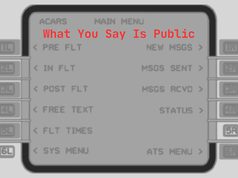










































Last month, you read how ACARS (Aircraft Communications Addressing & Reporting System) data is public and easily accessible. While ACARS is a great link between crews and dispatchers, it has its limits. Let’s start by thinking about communications and clarity. Anyone who texts routinely with people of varying age groups will notice some age groups include more emojis to attempt to convey meaning. My two teenagers loathe calling someone on the phone to talk (except for older relatives, who don’t like to text). We’re working collectively on helping them get comfortable with verbal phone calls.
The statistics we hear on what percent of communication is verbal / non-verbal / the words themselves (38% / 55% / 7% respectively) are debated and used to “prove” that non-verbal communication is extremely important for understanding. (Go to https://www.psychologytoday.com/us/blog/beyond-words/201109/is-nonverbal-communication-a-numbers-game to read more on the debate.) Rarely addressed is how handicapped pilots and dispatchers are merely using the words themselves in text-based communication. How often have you had a misunderstanding with someone over what they said in a text, because the tone of voice was lacking?
What’s even worse, when using ACARS, is the nearly universal lack of emotion we can express. My iPhone has about 3,870 emojis (apparently accounting for various skin tones)! With ACARS, there’s pretty much no emojis! The system lacks what we love using on phone texts to attempt to add “tone” to our words. How often have you yelled “OK” to someone in a happy tone versus an angry or frustrated tone? Over text, it just isn’t clear what “OK” really means!
Recently, while talking with other dispatchers, I learned some dispatchers and flight crew attempt to use onlyACARS for involved, complicated discussions. As I’ve experienced with my own teenagers, it may seem more appealing to younger dispatchers to default to ACARS for sorting out problems.





Most of the time, ACARS is just fine for simple messages. But, if a dispatcher has lots of information to describe or provide, it is often faster to just talk directly to the crew. Each party in the communication benefits from hearing tone of voice and using that context. A key aspect of tone includes recognizing the other person’s willingness to go along with – or reject – the proposed plan.
With irregular operations, voice can really save time, reduce confusion, and stop frustration. If a thunderstorm moves through a hub, the dispatcher may have multiple flights due to land within ten to 20 minutes of each other. When all four flights are assigned holding within a short period, the dispatcher must quickly reach all the flights with updated fuel numbers and agree on contingency plans. If the dispatcher tries to send all these updates by ACARS, they can be confused with potentially information being sent to the wrong flight. But if the dispatcher uses voice-over radio, all flights will hopefully hear the general conversations and understand the dispatcher’s workload in providing holding fuel updates. As a bonus, each flight can hear the other’s instructions and gain added context for the weather and holding situation. To reiterate, tone is key. Crews can hear confidence (or lack of confidence) in voice plans with dispatchers. Each person involved can feel out the other’s perspective more easily over voice, especially when information must be received quickly.
Communication is best when dispatchers put themselves in the flight crew’s place and view their role in making the crew’s flight operate more smoothly, while enhancing safety. Dispatchers have a huge advantage of normal keyboards and quick typing skills, while flight crews are frequently stuck with rudimentary keypads with non-standard layouts and almost no punctuation. Dispatchers need to understand that sometimes the crew is going to take a while to respond by text, and insisting on long/complicated conversations held over ACARS has great potential for frustration.
So, if you’re a dispatcher, get comfortable using the radio (or satphone, if available). Before launching into complicated conversations over ACARS, stop and consider using voice. Ask yourself how you can make the flight crew’s life easier.