

























































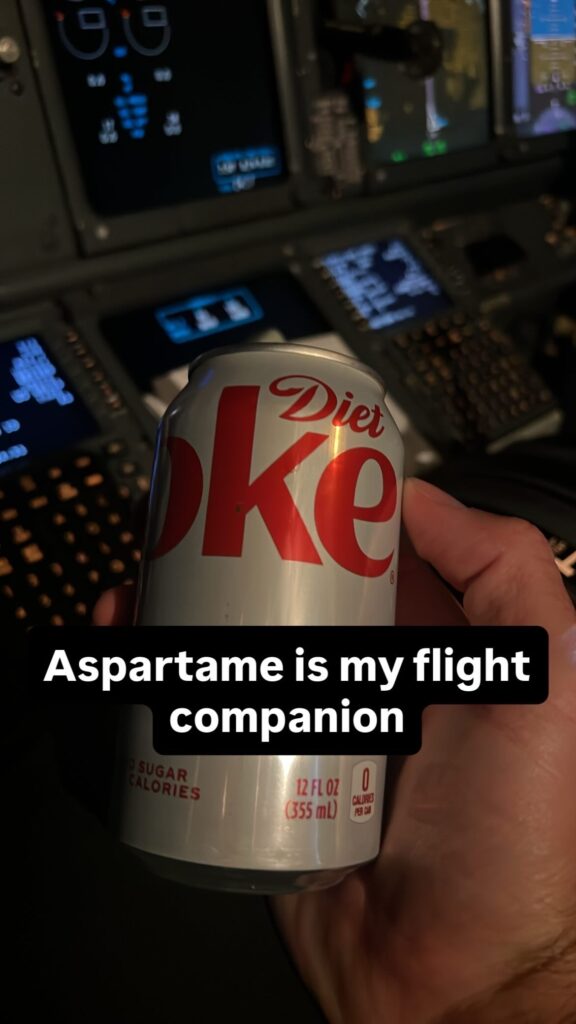
It’s 8 p.m., ten minutes to pushback, and you know what I could go for? My outstanding flight attendant asks before closing the door, “Do you guys need anything?”
I wryly reply, “Some high-quality ASPARTAME—an ice-cold Diet Coke.” Most flight attendants miss the Adam Sandler Waterboy reference when I drop that line. But it’s true. I love a Diet Coke before a night leg. Now the question is: Should I love it?
Artificial sweeteners get praised and vilified about as often as Taylor Swift drops a new album. Do we have to pick a side, or can we just look at the data and decide where aspartame really fits into our lives? As a nutrition coach—and self-confessed Diet Coke fiend—here’s what I’ve found.
The Bad:
In 2022, a large French study (Debras et al., PLOS Medicine) followed more than 100,000 adults and found that higher intakes of artificial sweeteners—especially aspartame and acesulfame-K—were associated with an increased risk of cancer, particularly breast and obesity-related cancers.


Sounds bad, right? Yeah, I didn’t love reading that either. My defensive ego thinks, “Well, the sun causes cancer too.” But let’s unpack it.
People who drank the most artificial sweeteners had about a 13% higher relative risk of developing cancer than non-users. That sounds scary until you remember this: it’s an observational study, not proof of cause and effect. In plain English—researchers saw a pattern, but they can’t say aspartame caused cancer. Other lifestyle factors, like body weight or diet quality, could easily play a role.
And for context? Even light alcohol use increases certain cancer risks by 20–30%, and heavy drinking can double them. If aspartame were truly harmful, it would still be light turbulence compared to the storm alcohol creates for your cells.
Regulatory bodies like the U.S. Food and Drug Administration (FDA) and the World Health Organization’s Joint Expert Committee on Food Additives (JECFA) continue to state that aspartame is safe at current consumption levels. So, is aspartame “good” for you? Probably not. But is it better than the alternative? That’s where the story changes.
The Good:
Let’s talk about sugar—the real villain in this story.
A regular 12-ounce Coke contains about 39 grams of sugar, or 10 teaspoons—that’s more sugar than the American Heart Association recommends for an entire day. Decades of research show what that does to your body: A 2020 meta-analysis in JAMA (formerly known as the Journal of the American Medical Association) Internal Medicine found that people who drank one or more sugary beverages per day had a 26% higher risk of developing type 2 diabetes.
A 2019 Circulation study linked each daily soda to a 21% higher risk of heart disease and increased all-cause mortality.
Other data connect sugar-sweetened drinks to higher risks of dementia, weight gain, and fatty liver disease.
For pilots and flight attendants—people living on the edge of fatigue, irregular meals, and long sits—sugar spikes and crashes are the last thing we need. In comparison, artificial sweeteners don’t raise blood sugar or insulin and have even shown weight-management benefits when used to replace sugar.
Now, there is such thing as TOO much aspartame. Both JECFA and the European Food Safety Authority (EFSA) set the Acceptable Daily Intake (ADI) for aspartame at 40 milligrams per kilogram of body weight per day. To visualize that: One 12-ounce (355 mL) can of Diet Coke has about 180 mg of aspartame. So, a 150-pound (68 kg) person would have to drink roughly 15 to 18 cans every single day to hit the ADI—still considered safe by global standards.
So, let’s sum this up: Large studies like NutriNet-Santé show minor risk associations at very high intakes, but controlled trials—our gold standard—show no measurable harm to metabolism and even positive effects for weight control when sugar is swapped for zero-calorie alternatives.
So where does that leave us? What is the definition of health really? Ultimately that’s a very personal decision. Our job puts us in positions often degrading our health. Diet Coke, water, or low-calorie snacks, can help you on your health journey but will never be all encompassing.
My goal is to give you the facts so that you can make the decision for yourself rather than join the “good” or “bad” bandwagons. All drinks and foods that don’t make you sick, can serve a purpose in your nutrition. It’s up to you to decide what that purpose is—not to label them as “bad” or “good.”
So, if you’re craving something fizzy at cruise altitude, and you know that Diet Coke keeps you sane, focused, and away from the sugary stuff—relax. You’re doing just fine. Aspartame isn’t the hero nor is it the villain. It’s simply a tool—one that, when used in moderation, can help you fly a little lighter.
Resources:
Debras et al., 2022 – PLOS Medicine (NutriNet-Santé cohort)
Association between artificial sweetener intake and cancer risk https://journals.plos.org/plosmedicine/article?id=10.1371/journal.pmed.1003950
Magnuson et al., 2007 – Critical Reviews in Toxicology
Comprehensive toxicology review: no credible evidence of carcinogenicity at human doses https://pubmed.ncbi.nlm.nih.gov/17828671/
WHO / IARC, 2023 – Press release & Monograph on Aspartame (Group 2B classification)
“Aspartame hazard classification: possibly carcinogenic to humans” https://www.iarc.who.int/news-events/iarc-classifies-aspartame-as-possibly-carcinogenic-to-humans-2b/
WHO / FAO JECFA, 2023 – Risk assessment reaffirming ADI of 0–40 mg/kg/day
“Aspartame safety: JECFA evaluation maintains acceptable daily intake” https://www.who.int/news/item/14-07-2023-jecfa-evaluation-of-aspartame
EFSA, 2013√ Full re-evaluation of Aspartame Safety
“Scientific opinion on the re-evaluation of aspartame (E 951) as a food additive” https://efsa.onlinelibrary.wiley.com/doi/10.2903/j.efsa.2013.3496
U.S. FDA – Current Position on Aspartame Safety
“Aspartame and other sweeteners: FDA’s evaluation and position” https://www.fda.gov/food/food-additives-petitions/additional-information-about-high-intensity-sweeteners-permitted-use-food-united-states Comparative Risk — Alcohol & Cancer
Bagnardi et al., 2015 – British Journal of Cancer
“Light drinking and cancer risk: meta-analysis of cohort studies” https://www.nature.com/articles/bjc2015148
World Health Organization, 2023 – Alcohol and Cancer Fact Sheet“No safe amount of alcohol for health” https://www.who.int/news/item/04-01-2023-no-level-of-alcohol-consumption-is-safe-for-our-health Sugar-Sweetened Beverages & Metabolic Disease
Malik et al., 2019 – Circulation
“Long-term consumption of sugar-sweetened and artificially sweetened beverages and risk of mortality” https://www.ahajournals.org/doi/10.1161/CIRCULATIONAHA.118.037401
Imamura et al., 2015 – BMJ (Meta-analysis)
“Consumption of sugar-sweetened beverages, artificially sweetened beverages, and fruit juice and incidence of type 2 diabetes” https://www.bmj.com/content/351/bmj.h3576
Hu & Malik, 2010 – Journal of the American College of Cardiology
“Sugar-sweetened beverages and risk of obesity and metabolic syndrome” https://www.jacc.org/doi/10.1016/j.jacc.2010.03.038
Pase et al., 2017 – Alzheimer’s & Dementia (Framingham Heart Study) “Sugary beverage intake and preclinical Alzheimer’s disease and brain aging” https://pubmed.ncbi.nlm.nih.gov/28389426/
American Heart Association – Sugar Recommendations
“Added sugars: how much is too much?” https://www.heart.org/en/healthy-living/healthy-eating/eat-smart/sugar/added-sugars
Peters et al., 2016 – Obesity
“The effects of water and non-nutritive sweetened beverages on weight loss during a 12-week weight loss treatment program” https://pubmed.ncbi.nlm.nih.gov/26967853/
Harrold et al., 2024 – International Journal of Obesity
“Non-nutritive sweetened beverages versus water on weight loss and maintenance over 52 weeks” https://www.nature.com/articles/s41366-024-01516-1