


















































Editor’s Note: This month we launch Desk One, a new column relating to the art and science of dispatch. Joining us as a contributor for future columns is Laura Laster, an expert in the dispatch space. This month, the regular contributor for our weather column, Squall Lines, has written on the topic, and Laura has written for Squall Lines. You’ll recognize some crossover. Each author will return to their own columns in future issues.
“Wind shear. A sudden, drastic shift in wind speed, direction, or both that may occur in the horizontal or vertical plane.” – Airplane Flying Handbook, 2021 (FAA-H-8083-3C)
“Takeoff with full rated takeoff thrust is recommended if windshear conditions are suspected, unless the use of a fixed derate is required to meet a dispatch performance requirement.” – Boeing 737 NG/MAX Flight Crew Training Manual
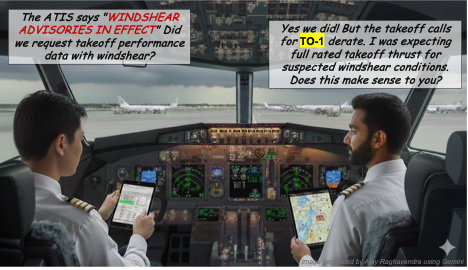
Conventional wisdom suggests that if windshear advisories are in effect, pilots should select the longest suitable runway, review key airspeeds, use maximum takeoff thrust and avoid reduced thrust takeoff settings (e.g., Assumed Temperature Method or Fixed Derate), maintain initial climb pitch attitude and thrust setting until a safe terrain and obstruction altitude is achieved. Recommendations for windshear encountered after V1 include continuing takeoff by disconnecting auto throttle (if applicable), maintaining maximum thrust, and higher pitch attitude. For more information, please read my article on Windshear: The Science, Equipment, and Mitigation in the February 2024 issue of Aero Crew News.





Naturally, I was perplexed when the Boeing 737 FCTM advocated for the “use of a fixed derate is required to meet a dispatch performance requirement”. Two questions came to my mind: Why should I use a reduced thrust takeoff in environmental conditions ripe for windshear? And what does Boeing mean by “dispatch performance requirements”? The answer to the second question was relatively straightforward i.e., “dispatch performance requirements” are the regulatory and safety-based calculations that determine if an aircraft can safely take off, fly, and land under specific conditions. Before any flight, the flight crew and dispatchers must prove that the airplane can meet certain benchmarks i.e., proving that the aircraft weight is acceptable for the given environmental constraints. The answer to the first question required some additional study and research work that I have summarized below.
The dispatch performance requirements typically entail:
1. V1 Decision Speed and Runway Length: The most critical requirement is the Accelerate-Stop Distance. If an engine fails just before takeoff speed (V1), the aircraft must be able to stop within the remaining runway. Conversely, if it continues, it must be able to clear any obstacles at the end of the runway on a single engine. Balanced field takeoff is an important factor to consider, especially when takeoff engine thrust settings are reduced (derate and/or assumed temperature method).
Note: Higher the takeoff thrust setting, higher asymmetric thrust in the event of an engine failure. Since the V1 decision speed takes into consideration the Minimum Control Speed (Vmcg/Vmca; 14 CFR § 25.107), using a fixed derate (a permanent electronic limit on engine thrust) helps lowers the V1 decision speed. Reduced takeoff thrust settings allow for lower takeoff speeds and better performance on short or contaminated runways.
2. Takeoff Flight Path i.e., Terrain/Obstacle clearance and Engine Failure Procedure (EFP): Even if you get off the ground, performance data should support the aircraft to safely climb away from terrain and obstacles. Dispatch requirements dictate that the airplane must maintain a specific climb gradient (e.g., 1.2% for two-engine airplanes per 14 CFR § 25.111) to clear obstacles like mountains or towers.
3. Structural vs. Performance Limits: A plane might be structurally capable and certified for 170,000 lbs. maximum gross takeoff weight (MGTW), but if the aircraft is departing on a short or contaminated runway, at high density altitude (temperature or airport elevation), or takeoff flight path constrained (e.g., Obstruction NOTAM), the maximum runway takeoff weight (MRTW) may be 140,000 lbs. You cannot dispatch the flight if the actual weight exceeds the performance-limited weight.
Note: Commonly used aircraft-performance software such as AeroData take into consideration aircraft weight, runway, environmental conditions (e.g., runway length, slope, breaking action, contamination, and weather), and NOTAMS to generate the optimal takeoff and landing performance solutions. AeroData solves this paradox for pilots. When a pilot sees “Fixed Derate Required” on their performance data, it is usually because the software found that the V1 required to stop on that specific runway was lower than the Vmcg at full rated thrust.
After reviewing typical dispatch performance requirements, a reasonable conclusion includes using every bit of power you have to get through potential windshear. However, if your performance calculations require a fixed derate to safely meet runway or obstacle clearance rules (often due to Vmcg issues on a short or slippery runway), then the performance calculations advocating for a reduced thrust takeoff overrides the recommended maximum thrust takeoff.
How does a Fixed Derate help with Vmcg and reduce the V1 Decision Speed?
When subjected to a contaminated runway (e.g., standing water, slush, or ice), you not only loose braking action but also directional control if an engine fails. A fixed derate can keep you on the pavement. Vmcg is the minimum speed at which you can lose an engine and keep the airplane on the runway centerline using only the rudder. Therefore, if you encounter an engine failure, we must promptly reject a takeoff at speeds below V1 since directional control is not guaranteed and continue takeoff above V1 since there is a high risk of a runway overrun.
The Fixed Derate Solution
High Thrust ⟹ High Thrust Asymmetry in the event of an engine failure. Low Speed ⟹ Weak Rudder effeteness. At low speeds, there isn’t enough airflow over the rudder to fight that massive thrust asymmetry. The Result: If you lose an engine below Vmcg, the plane will veer off the side of the runway before you can even lift off. By using a fixed derate, you are “capping” the maximum thrust the engine can produce for that takeoff. Lower Thrust ⟹ Lower Thrust Asymmetry in the event of an engine failure ⟹ Rudder can maintain directional control even at lower airspeeds ⟹ Lower Vmcg ⟹ Lower Takeoff Speeds (V1, VR, and V2). Since your Vmcg is now lower, you can legally and safely choose a lower V1 speed.
Why this is a “Dispatch Requirement“
If you are on a short, slippery runway, you need a low V1 so you’ll have enough room to stop if things go wrong. But you can’t pick a V1 that is lower than your Vmcg. For example, If the Full Thrust Vmcg is 130 knots, but your runway only allows a V1 of 120 knots, using a Fixed Derate will reduces Vmcg down to 110 knots. In this specific scenario, the derate is “required to meet a dispatch performance requirement“.
Stay tuned for my next article on windshear and takeoff thrust settings: Assumed Temperature Method vs Fixed Derate.