






































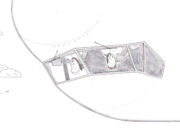

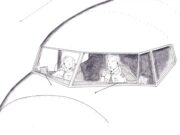



On January 25, 2026, at 1944 EST, Bombardier Challenger 650 N10KJ crashed shortly after takeoff from runway 33 at Bangor International Airport, Bangor, Maine, during a Part 91 business flight, fatally injuring the pilot, copilot, and four passengers and causing substantial damage to the airplane. The aircraft had departed William P. Hobby Airport in Houston at 1420:47 CST on the first leg of a planned transatlantic flight to Châlons Vatry Airport, France, and landed at Bangor at 1809:15 before taxiing to the FBO ramp, where both engines were shut down, the APU supplied electrical power, and the airplane was refueled with Jet A‑1 to a total of about 19,872 pounds of fuel.
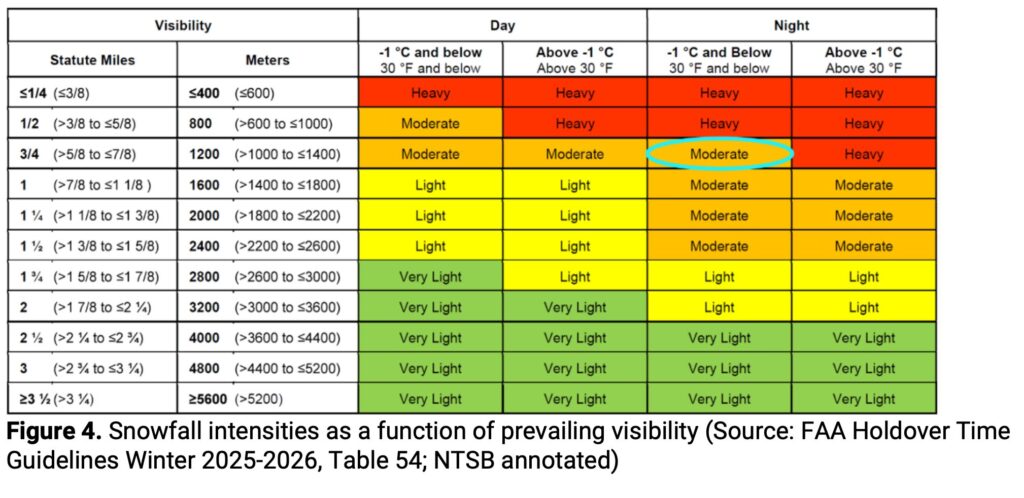
At 1913:42 the airplane taxied from the FBO to the deice pad, stopped at 1917:46, and shut down the engines for deicing; between 1919:26 and 1927:04 about 41 gallons of Type I deicing fluid were applied, followed by 28 gallons of Type IV anti‑ice fluid from 1927:43 to 1930:55, in night conditions with 3/4‑mile visibility, light snow, temperature -16°C, and surface wind from 040° at 6–8 knots. After anti‑icing, the airplane remained on the pad for 4 minutes 51 seconds, then taxied off at 1935:46; while taxiing to runway 33, the crew discussed holdover times, with the pilot describing a “standard” 14–18 minute window and planning to return for deicing if the delay exceeded 30 minutes, and the copilot agreeing.
The airplane stopped about 200 feet short of the runway 33 hold‑short line at 1940:16, received and acknowledged takeoff clearance at 1943:04, and began takeoff at 1943:57 with 20° flaps, pitch trim set to -4.8°, and wing and cowl anti‑ice systems on, as engine power increased toward 85 percent takeoff thrust. The copilot called takeoff power set and airspeed alive at 1944:05, called 80 knots at 1944:10, then V1 (136 KIAS) at 1944:18 while the FDR showed 127 KIAS, and VR (139 KIAS) at 1944:22 when the FDR showed 140 KIAS, coincident with the nosewheel and then main gear indicating airborne.
FDR data showed that at 1944:25 the airplane was about 6 feet above ground with approximately 13° nose‑up pitch, about 19° angle of attack, and wings nearly level; about one second later it was at 11 feet, about 11° nose‑up, in 1–2° left roll with about 20° angle of attack when both stick shakers activated for about one second. By 1944:27 the airplane was at 14 feet, about 9° nose‑up, about 16° angle of attack, and transitioning from left to right roll, with both ailerons at their travel limits consistent with full left‑wing‑down control input; by 1944:30, just before FDR data ended, the airplane was about 6° nose‑up with approximately 77° right‑wing‑down bank, and both stick shakers activated again while the radio altimeter indicated 31 feet, a value likely affected by the bank angle.



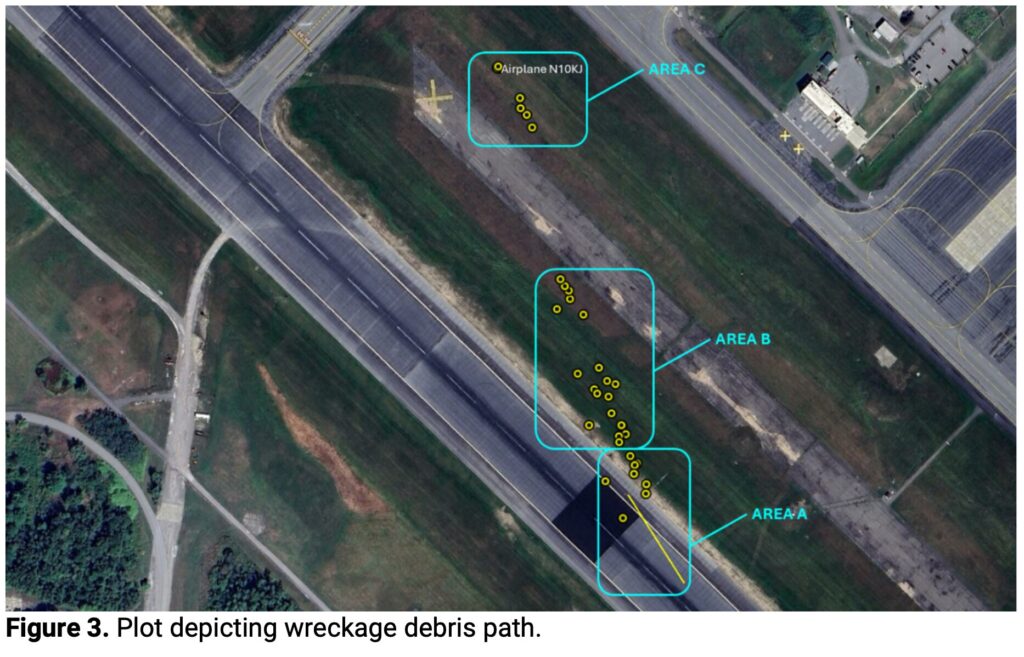
A preliminary FDR review found no evidence of flight control malfunction or failure, and both engines continued to produce takeoff power until the end of the recording. CCTV cameras captured the takeoff, ground impact, and multiple explosions; runway evidence began about 5,808 feet from the runway 33 threshold, 42 feet right of centerline, with scrape marks on a 338° magnetic heading and a wide fuel‑residue area shifting toward about 355° near the right runway edge. The airplane exited the right side of runway 33 into the grass safety area about 20° right of runway heading, leaving a debris path about 1,270 feet long and 150 feet wide that included the right winglet and both winglet tips, windshield sections, the main entry door, flight‑deck components, and engine parts; the airplane came to rest inverted on a 355° magnetic heading, with the cockpit, cabin, and empennage showing thermal damage from a prolonged post‑impact fire, fuselage damage between the main entry door and wing root consistent with rescue efforts, both wings still attached, both engines partially attached with debris, foam, and ice in the inlets, the nose and main landing gear extended, and no evidence of pre‑impact separation of any component, flight control, or structure.
The report notes that, under the FAA Winter 2025–2026 Holdover Time Guidelines, the prevailing visibility and temperature at the time of anti‑icing corresponded to “moderate” snowfall, giving a maximum 9‑minute holdover time for the Type IV fluid used, measured from the start of anti‑ice application. The wreckage has been moved to secure storage for further examination, and ongoing investigative work includes aircraft operations, aircraft performance, flight recorders, airport operations, survival factors, and human performance, with a transcript of relevant cockpit voice recorder content to be released as part of the continuing investigation.
Click here to view the full NTSB report.