

















































I’ve discussed base salary and total cash compensation extensively in the articles I’ve written here, so this month I thought I’d turn to a form of compensation that is becoming increasingly popular in business aviation circles—long-term incentive payments (LTI). Unlike yearly short-term incentive payments or bonuses, LTI payments are typically awarded on a yearly basis, but they required a vesting period that is typically three to five years before the employee receives the associated funds.
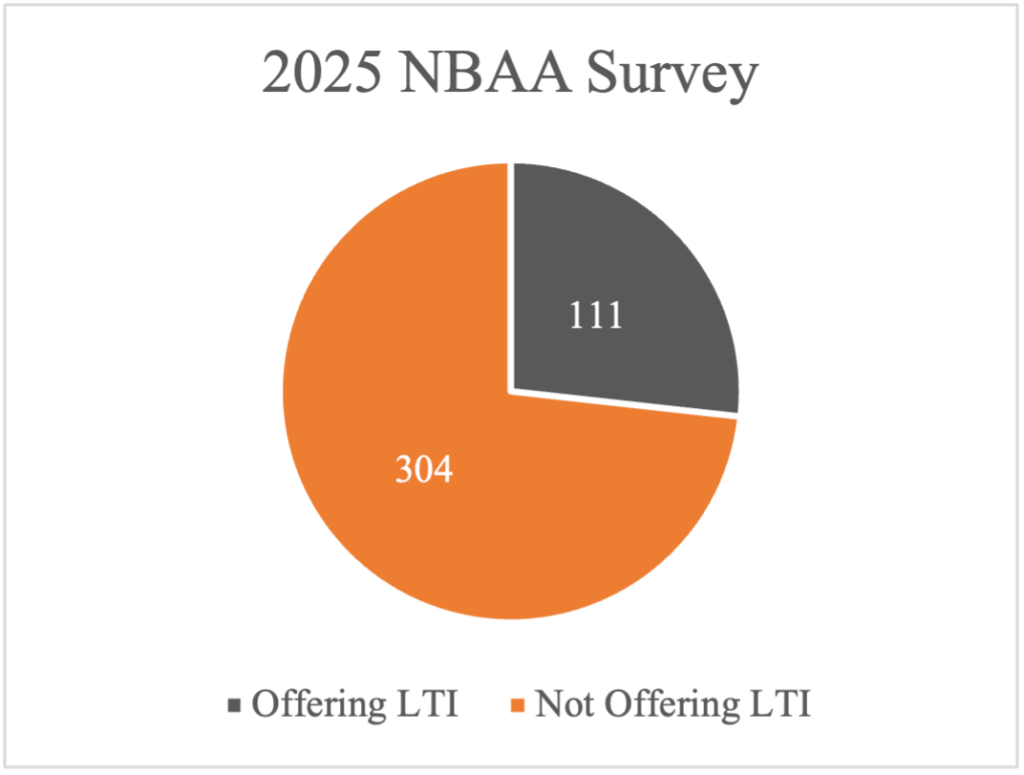
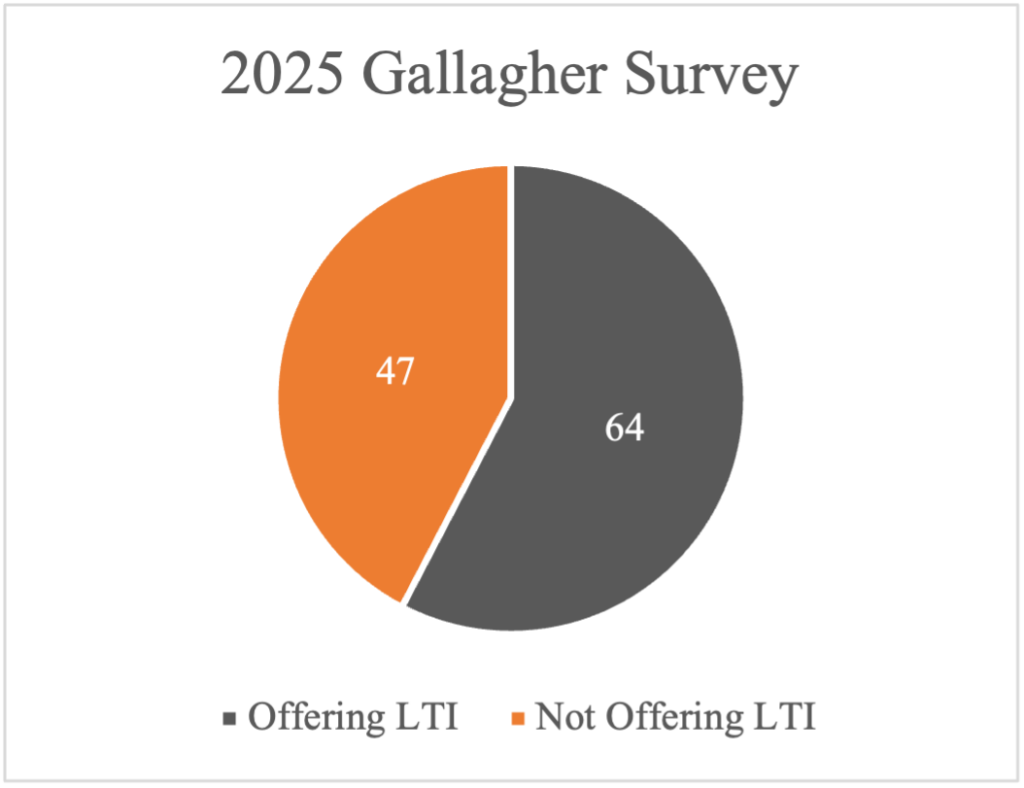
Companies Offering LTI – 2025 Survey Data
(National Business Aviation Association, 2025) (A.J Gallagher and Associates, 2025)
The NBAA and Gallagher surveys provide two different views of the same population. As I’ve mentioned before, the NBAA survey tends to capture smaller organizations, 10.7 personnel/organization in 2025, and the Gallagher survey captures larger organizations, 41.7 personnel/organization in 2025). Since Gallagher captures larger organizations and corporate flight departments, it’s not a surprise that the percentage of organizations offering LTI is higher in that sample.



LTI payments come into two categories, equity or cash. For publicly held companies, equity is most common, with Restricted Stock Awards being the most popular form. For privately held ones, cash is the usual mechanism. The chart and notes below depict how LTI mechanisms are distributed into the two survey samples, along with a brief description of each type of LTI payment.
| Survey | Restricted Stock Awards1 | Other2 | Performance Shares3 | Long Term Cash4 | Incentive Stock Options5 | Non-Qualified Stock Options6 |
| NBAA | 47% | 14% | 5% | 23% | 6% | 5% |
| Gallagher | 64% | 0% | 11% | 7% | 3% | 7% |
| Weighted Average | 57.6% | 5.1% | 8.7% | 12.6% | 4.2% | 6.1% |
1. Restricted Stock Award (RSA) – Grants of stock or stock units subject to restrictions until the employee has worked for the company for a specified period. The employee may receive or accrue dividends during the vesting period.
2. Other – Includes Performance Units, Phantom Stock and Stock Appreciation Rights.
3. Performance Shares Plan – A conditional stock or stock unit award plan in which the payout is determined by the company’s achievement of specified performance goals over several years. The value of the share is equal to market value of common stock at end of performance period Stock Option (NQSO).
4. Long-Term Cash Award – Cash paid out based on growth or decline of grant amount over a specified multi-year period.
5. Incentive Stock Option (ISO) – An option that qualifies for favorable tax treatment (no tax at exercise and treatment is at capital gains tax rate), granted to an employee to purchase company stock at a specified price for a specified period.
6. Non-Qualified Stock Options (NQSO) – An option that does not qualify for favorable tax treatment (tax at exercise), granted to an employee to purchase company stock at a specified price for a specified period. Also called non-statutory stock option.
LTI Mechanisms
(National Business Aviation Association, 2025) (A.J Gallagher and Associates, 2025)
So, which employees in an organization receive LTI? That depends on the compensation philosophy and pay structures of the company. In some companies, LTI payments are only made to those in leadership positions. In others, they’re made down to the line-employee level. The chart below shows percentages of personnel in different business aviation jobs who received some form of LTI in 2025.
| Position | NBAA Percentage | Gallagher Percentage | Weighted Average |
| Avionics Technician | 3% | 0% | 2.1% |
| Captain | 19% | 30% | 23.1% |
| Chief Pilot | 26% | 54% | 34.1% |
| Director of Maintenance | 22% | 39% | 26.7% |
| Director/Aviation Manager (Flying) | 35% | 66% | 38.3% |
| Director/Aviation Manager (Non-Flying) | 35% | 72% | 61.4% |
| First Officer | 12% | 30% | 20.1% |
| Flight Attendant | 9% | 15% | 11.9% |
| Flight Coordinator/Office Manager | 6% | 19% | 9.4% |
| Flight Technician | 6% | 12% | 11.8% |
| Line Service Technician | 3% | 11% | 4.2% |
| Maintenance Assistant | 16% | 11% | 13.9% |
| Maintenance Supervisor | 11% | 18% | 14.4% |
| Maintenance Technician | 7% | 6% | 6.8% |
| Scheduler | 5% | 9% | 6.3% |
| Senior Captain | 22% | 39% | 30.3% |
| Senior Flight Attendant | 19% | 23% | 21.3% |
| Senior Scheduler | 5.5% | 6% | 5.6% |
LTI Payments to Aviation Department Employees
(National Business Aviation Association, 2025) (A.J Gallagher and Associates, 2025)
I know there are many people in our industry who are very cash focused. I’m not one of them. I’m a big believer in LTI because it provides “stickiness” to the retention equation, or what is more euphemistically referred to as “golden handcuffs.” As LTI payments are made over the years and begin to vest, then if an employee departs, he or she will be leaving money on the table. Let’s say that an employee gets an annual LTI award in the form of RSAs that equal $30,000. And let’s say that $30,000 vests 1/3rd annually, so the employee gets $10,000 in year one, $10,000 in year two, and $10,000 in year three. What actually happens though, is that as the LTI payments are made, they start stacking. In year two, the employee receives $10,000 from the LTI award made the prior year and $10,000 from the current year award. By year three, the employee is actually receiving $30,000, the final $10,000 from the two years previous award, $10,000 from the previous year, and $10,000 from the current year. From that point forward, they’re receiving $30,000 every year, but if them resign, they’ll leave at least $20,000 on the table.
Another reason I’m a fan of LTI payments is because they keep us, as employees of a business, engaged in that business and engaged in the success of the company. One of the biggest predictors of an aviation department’s longevity and continued existence is the degree to which it is aligned with the larger company’s objectives. LTI can be a tool to incentivize that alignment.
As always, feel free to reach out with any questions you might have on LTI or any business aviation compensation matter. You can reach me at [email protected].
Bibliography
A.J Gallagher and Associates. (2025). 2025 Aviation Compensation Survey. Quincy, MA, US: A.J. Gallagher and Associates.
National Business Aviation Association. (2025). 2025 NBAA Compensation Survey. Washington, DC, USA: National Business Aviation Association.