






















Laura Early sat in the FBO at the Brunswick Golden Isles airport, nervously awaiting someone she had never met, about to do something she had never done. She was still getting her feet under her as a new Waterkeeper, and one of her mentors was going to show her how to use a SouthWings flight. Jen Hilburn, then Altamaha Riverkeeper, frequently used SouthWings flights to gather important information to hold polluters accountable, particularly regarding coal ash ponds and the paper industry.
SouthWings Volunteer Pilot Woody Beck flew in from Athens, Georgia and walked into the FBO with a smile on his face and an Altamaha Riverkeeper hat on his head. He greeted them and explained that it was pretty windy that day and consequently, would be a bumpy flight.
SouthWings provides pro bono flights across the Southeast and Gulf by bringing together volunteer pilots, nonprofit organizations, government agencies, and decision makers to provide one-of-a-kind aerial experiences. The flights offer a perspective that fosters understanding of the scale and the relationship of cumulative environmental effects, helping to better understand and solve the most pressing environmental issues facing the region.
Laura’s charge was the Satilla River watershed, just south of the Altamaha. It flowed from Douglas, Ga. to the Atlantic Coast between Jekyll Island and Cumberland Island. In order to effectively protect the Satilla River watershed, she had to understand the river system and know what was happening throughout the watershed. This meant monitoring it from all angles, the ground, the water, and the air.

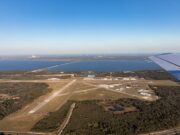
As they left the runway and climbed into the air, the interconnectedness of water on this coastal Georgia landscape was immediately evident. The tide came right up to the edges of industrial facilities, something you couldn’t see from the water because of manmade berms just a few feet higher than the high tide. They flew south from the airport to the estuary in Camden County, where a man-made cut between the main channel of the Satilla River and tidal creeks had altered the hydrologic flow for decades. Aerial photos that Laura took on the flight would be used for years to illustrate the issue and advocate for ecological restoration, eventually resulting in a multimillion-dollar project to close the cut, return a natural tidal flow, and restore habitat. The efforts were supported by the local community as well as state and federal agencies.
Flying upriver from the mouth, the web of tidal creeks transitioned into a meandering blackwater river lined with cypress and tupelo. The view from 2000 feet above was something else entirely. Not only did it reveal the beauty of this river, but there was a spatial awareness that you can’t get from ground level or a map.
Back on the ground in Brunswick, Woody helped Laura climb out of his Cessna 177. The abundance and connectedness of wetlands just beyond the rivers’ banks that she viewed during the flight were what Laura would take with her as she continued her tenure as the Satilla Riverkeeper.
SouthWings Origin Story
SouthWings was co-founded in 1996 by friends and pilots Hume Davenport and Jay Mills. The former was a volunteer pilot for LightHawk, an organization based in the western U.S. dedicated to accelerating conservation success through the powerful perspective of flight. Davenport brought this idea back to the Southeast, and founded SouthWings along with Mills in Chattanooga, Tennessee. Together, they envisioned an organization that would use pilots and planes to document landscape-level environmental impacts in the Southeast.
“It was clear to me early on how important the aerial perspective is to winning over public opinion on conservation issues,” says SouthWings founder Hume Davenport. “There is so much you cannot see from the ground that immediately becomes visible from a small aircraft.”
The first initiative they sought to bring to the public’s attention was extensive clear cutting on the Cumberland Plateau. Davenport flew monthly survey flights to determine sourcing areas and methods of a newly constructed wood chip mill which was cutting down the forests at alarming rates. Groups on the ground, like the Dogwood Alliance, had begun organizing around this issue and SouthWings was there to provide the aerial perspective.
SouthWings Scope of Work
SouthWings’ work began to expand to other conservation initiatives around the Southeast, and soon mountain top removal coal mining became a top focus of the organization. It’s a destructive practice that poses significant public health risks and has destroyed over 500 mountains in Appalachia. Heavy explosives are used to blast off the mountain top in order to access the coal below. Flying over one of these sites can be an extremely impactful experience that can inspire individuals to pursue positive change.

As with deforestation and just about every other destructive environmental practice, it can be hard to see from a car or boat. Thin layers of forests can veil what lies just beyond. Seeing it from a plane not only reveals what is hidden but also helps to understand the scope and severity of an issue. “SouthWings flights afford us a perspective that we can’t get from the ground or even by drone flights, revealing the scale of mountaintop removal and proximity to communities,” says Vernon Haltom, executive director of Coal River Mountain Watch. Vernon flies several times a year with SouthWings volunteer pilots to monitor the activities at mountain top removal coal mining sites and report suspected permit violations to the West Virginia Department of Environmental Quality. His videos provide transparency that neither the state agency nor the industry affords to the public.
Since the establishment of a Gulf Coast office in New Orleans during fall 2012, SouthWings has greatly enhanced its work to protect ecosystems, including promoting watershed health and preserving wildlife habitat in the Gulf region. Along the Gulf Coast, flight partners keep a watchful eye on chronic and intermittent oil leaks from abandoned and improperly maintained offshore oil platforms through the support of SouthWings volunteer pilots.
In 2010, SouthWings flights confirmed an ongoing spill from offshore oil wells owned by Taylor Energy. Subsequent flights documented visible oil polluting the Gulf of Mexico, which appeared to be substantially more than was being reported by the company or by regulators. From 2010 to 2023, SouthWings volunteer pilots conducted 35 flights over the site for partners seeking accountability. While other legal issues around the spill are unresolved, over a decade of hard work paid off in 2022 when Taylor Energy finally agreed to a settlement and to stop the spill.
Like the Satilla and Altamaha Riverkeepers, SouthWings flights support many Waterkeeper Alliance partners in monitoring watershed threats from urban development, livestock waste, coal ash, and other pollution sources. In one year alone, SouthWings flights enabled over 180 pollution reports to be filed with state and federal agencies to hold polluters accountable, and coverage of these flights in Rolling Stone and by NPR have brought these issues to national attention.

The Vision and Process
SouthWings envisions the Southeast as a landscape of healthy communities that value and cooperatively steward natural, cultural, and economic resources. SouthWings helps ensure that the region’s unique identity and globally significant biodiversity are held in trust for current and future generations.

This vision becomes a reality by crafting flight experiences that provide passengers with the inspiration and evidence needed to protect and restore ecosystems and communities that are facing environmental threats. SouthWings has flown thousands of individuals and organizations to gather relevant data, determine the best strategies to solve environmental problems, and target individuals with the greatest potential to influence positive change—from reporters and photographers to legislators and community leaders. The tool of flight is a capacity builder, and any group, no matter how large or small can request a flight from SouthWings.
Once a flight request is received, SouthWings program directors begin the collaborative process of flight planning. This involves conversations with the flight partners to identify points of interest and devise a flight path. Each flight request needs to have a clear objective and expected outcome, though it is understood that flight results may not be immediate or easily measurable. With the flight details identified, the program director will reach out to volunteer pilots to identify the best fit.
Time and again, passengers report back to SouthWings that the flight experience was illuminating, motivating and most importantly, helpful to their work. Partner organizations use flight data and/or photos in public presentations, online media, or campaign materials to educate their membership and the general public about critical environmental issues. And they come back for more. The majority of passengers on SouthWings flights have flown with the organization multiple times.
The Volunteer Pilots
SouthWings is a proud member of the Air Care Alliance and the nationwide network of Volunteer Pilot Organizations that engage in public-benefit flying by providing crucial aerial support to causes that make a difference. At the heart of the work is the commitment of SouthWings’ all-volunteer pilot corps, collectively contributing hundreds of hours of time and resources each year to provide a unique perspective on environmental issues that would otherwise not be possible.
SouthWings is able to offer these flights free of charge because of the incredible generosity and passion of the volunteer pilots who are the heart and soul of this organization. There are currently 81 volunteer pilots on the active roster throughout the SouthWings service area, which encompasses 15 states throughout the Chesapeake Bay watershed, Appalachia, the East Coast into the northern half of Florida, and the Gulf states as far as coastal Texas. SouthWings pilots fly all types of aircraft: SEL, a few twin engines, seaplanes, and helicopters are in the fleet.
In addition to their skills as pilots, many SouthWings’ volunteers bring extensive knowledge of conservation issues from their jobs in biology and environmental science or from other volunteer work as board members of groups like American Rivers, or local watershed and land protection organizations. Other SouthWings volunteer pilots are experts in the fields of engineering, law and medicine, and several are full time airline pilots who relish the chance to fly GA on their days off. Without a dedicated corps of volunteers, none of SouthWings’ work would be possible.


The purpose of a SouthWings flight is not to get from point A to point B, but rather to study what is on the ground, often circling points and flying low and slow to get photo documentation. SouthWings volunteer pilots often report that the flying required on a SouthWings flight is the most fun type of flying they do. Beyond that, it brings a great sense of pride knowing that they are doing something positive with their flying.
Volunteer Pilot Doug Oakley framed it this way, “I would tell new recruits the quiet feeling of accomplishment when I saw a story on coal ash ponds, wood pellet exporting, the red wolf reintroduction in N.C., and let’s not forget the CAFO (concentrated animal feeding operation) stories—all of these make me proud to have flown for something my wife and I believe in. I could not fly for the $100 hamburger without feeling I should have used that time and money to scout out the Cape Fear River or circle some CAFO sites and put some real purpose behind my flying.”
Pilot Requirements
As a volunteer-based organization, the first requirement to join SouthWings as a pilot is one who is willing to cover the cost of flight, including fuel. There would be no SouthWings if not for the generosity of its volunteer pilots. A pilot must also have at least 750 PIC hours. With this much experience, a pilot will have reached a level of comfort with the specific type of flying that is required on a SouthWings flight—repeated circling and maneuvering to view specific points on the ground. While many SouthWings pilots are IFR rated, it is not a requirement. SouthWings flights are scheduled for good weather VFR days for optimal ground visibility.
Beyond this basic requirement, one must maintain a valid pilot and medical certificates (or BasicMed), and own or have access to a regular category single- or multi-engine land or seaplane, or a helicopter. SouthWings does not arrange flights in ultra-light, experimental, or homebuilt aircraft. Adequate liability insurance is required, and a pilot will be asked to name SouthWings as additional insured on one’s policy.
Pilots interested in signing up can fill out an inquiry form on SouthWings’ website and a staff member will reach out to begin the conversation. After an initial phone call, the pilot will be invited to complete an application and submit accompanying documentation. Once everything is in hand, an orientation call will take place and then the pilot will be ready to accept a flight request.
30 Years of SouthWings
SouthWings is celebrating 30 years of providing the tool of flight to environmental initiatives in the Southeast. At the start of this year, Co-Founder Hume Davenport stepped down as board chair and longtime Volunteer Pilot and Board Member, Hap Endler, took the helm. A graduate of Appalachian State University and a former U.S. Navy aviator, Endler brings a lifetime of flight experience and a passion for meaningful service to his work with SouthWings.
Endler first became involved with SouthWings after a chance conversation with Davenport—a conversation that Endler recounts with a smile, saying Davenport “strong-armed me into SouthWings.” He has served on the SouthWings Board of Directors since 2013 and has been a dedicated volunteer pilot since 2008, flying scores of missions that have helped partners better understand and respond to environmental challenges.
“Hap’s deep connection to SouthWings and to our mission makes him a natural leader for our organization,” said SouthWings Executive Director Meredith Dowling.
Hap owns and flies a Cessna 182 out of the Asheville Airport, and he relishes the opportunity to put passengers in a position to see the mountains, wetlands, and waterways of the Southeast from a perspective few get to experience.
Reflecting on his new role, Hap shared, “I’m honored to take over the chairmanship of this 30-year-old organization. SouthWings has always been about showing up for communities and using aviation as a force for good, and I’m excited to help guide the organization into its next chapter.”
The victories over the past 30 years are what propels SouthWings into the future and keeps their volunteer pilots and staff looking forward to 30 more years of conservation through aviation.