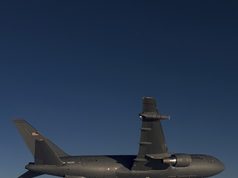





















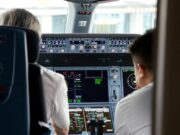




















The National Transportation Safety Board has released an explanatory animation and airport surveillance video related to the crash of UPS Flight 2976 on November 4, 2025. The Boeing MD-11F cargo aircraft lost its left engine shortly after takeoff from Louisville Muhammad Ali International Airport, ultimately impacting buildings and the ground. All three crewmembers and 11 people on the ground were killed. The animation details how fatigue cracking in the engine’s wing attachment hardware led to the separation of the left engine and pylon during takeoff.
Video Transcript
This animation illustrates the construction of the MD-11F aircraft engine attachments and presents investigative findings regarding the separation of the left engine.
The MD-11F has three engines, two wing mounted and one tail mounted. The left and right engines attach to the wings through a structure called a pylon, highlighted in blue. This illustration shows the frame of the pylon, which connects to the wing at three attachment points. The pylon aft mount, the pylon forward mount, and the thrust fitting, which is behind the pylon forward mount.
This three-dimensional model of the pylon aft mount will be used to explain the details of the attachment and how it failed in the accident. The aft mount consists of two triangular-shaped plates, which are bolted together. The pylon aft mount is attached to a wing clevis located on the underside of the wing structure. At the top of the plates forming the aft mount are the forward lug and the aft lug, which fit into the wing clevis.





The connection is made with a bolt, which passes through a bushing and is secured by a nut. The bushing is secured with a collar. The bushing features a grease fitting connected to internal passageways that channel grease throughout the assembly. The assembly includes a spherical bearing housed within the forward and aft lugs at the upper end of the aft mount.
The spherical bearing is comprised of a mono ball that sits within a one-piece outer race which conforms to the spherical shape of the ball and distributes loads uniformly across the aft mount lugs. The mono ball can rotate and move slightly within the outer race. This movement is designed to reduce stress in the assembly as the engine weight, aerodynamic forces, and engine thrust loads flex the structure during normal operations.
The mono ball contains shallow grooves on its inner and outer surfaces with three equally spaced holes to distribute grease. The outer race also contains a shallow groove on its inner surface to help with grease distribution. This lubrication groove is approximately 1/4 in wide, centered along the width of the race, and extends around the circumference of the inner surface.
The outer race from the accident showed fatigue cracking initiating from several locations around the inner surface at both the forward and aft corners of this lubrication groove. The fatigue cracks grew outward over time through the outer race thickness. Eventually, the fatigue cracks at the forward corner of the groove grew large enough for the outer race to split into two pieces.
With the outer race separated into two pieces, loads were no longer evenly distributed across the lugs. The two pieces of the separated outer race could be forced out of the bore of the lugs, resulting in abnormal loading on the lugs. Fatigue cracks initiated within the bore of both lugs at both the inboard and the outboard sides. These fatigue cracks grew outward through the lugs. During the accident flight, the lugs could no longer carry the load and completely fractured at the inboard side, then bent and separated at the outboard side.
With the pylon aft mount lugs fractured, the aft end of the pylon was no longer attached to the wing clevis. The remaining two pylon connections subsequently failed, resulting in separation of the left pylon and engine from the airplane during takeoff. A surveillance video at the airport captured the takeoff rotation and separation of the left pylon and engine from the accident airplane.