








































After waxing poetic about phones, passenger rights, and common carriage the past few months, let’s move on to something completely different and more weighty.
Marty McFly: “This is heavy.”
Doc Brown: “There’s that word again, heavy…is there a problem with the Earth’s gravitational pull?”
No, the gravitational constant is still that—constant, and expressed as a function of parsecs, the formula for gravity (G) is 4.498 x 10⁻¹²pc3M⊙-1yr-2. (Our more eclectically oriented readers may recall that the record for the Kessel Run still stands at just over 12 parsecs—which is actually a measure of distance and not time.)




But returning to consistency though, what is not constant is the actual on-frequency use of the wake turbulence categories heavy and super. Which is what this article is really about.
“Heavy” and “super” are specific wake-turbulence categories defined by general aircraft weight, requiring increased separation (distance) behind them by other aircraft, during all phases of flight, to avoid potentially dangerous encounters with disturbed air as a result of lingering wingtip vortices.
So, let’s break this down a bit.
Wingtip vortices are circular, high-energy, tornado-like air currents that form at the tip of an aircraft’s wing as lift is generated. High-pressure air beneath the wing slips over the edge of the wingtips to the top and meets lower-pressure air above the wing (which has nothing to do with equal transit theory postulated by the FAA and does not explain how flight actually works – but we’ll return to this in a near-future article). These vortices created at the wingtips produce hazardous trailing wake turbulence, which is most powerful behind heavy, slow, “clean” aircraft. A clean configuration means all drag-inducing devices including landing gear, wing flaps, slats, and spoilers are retracted fully.
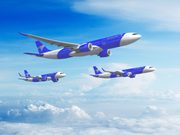
The term “super” applies to exceptionally large planes (1.2M lbs. or more) like the Airbus A380, and formerly the Antonov An-225 Mriya which was destroyed at Hostomel Airport in Ukraine during the Russian invasion in February 2022.
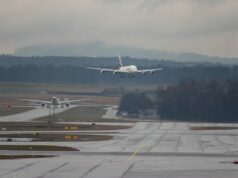
In fact, the super classification of wake turbulence was specifically designed for the A380 because it is so large, and in turn requires the largest separation distances, usually 6-8 nautical miles for aircraft flying behind them.
“Heavy” aircraft (more than 300,000 lbs.) include large aircraft such as Boeing’s 747, 757, 767, 777, and 787, as well as Airbus’ 330, 340, and 350. Medium (15,500-300,000 lbs.) to light aircraft (less than 15,500 lbs.) following behind these aircraft need between 4-6 nautical miles of separation in order to safely avoid their wakes.
These wake-turbulence separation categories are essential to safety during takeoff and landing, as the intense wingtip vortices can cause severe, uncontrollable, and even fatal upsets to smaller, following aircraft. Although pilots are certainly accountable for recognizing and monitoring the conditions likely to result in contact with wake turbulence, it is the responsibility of Air Traffic Control (ATC) to issue and conduct the appropriate separation between aircraft of different sizes in order to minimize the threat of negative encounters with wake turbulence.
Although pilots recognize that this separation process is occurring in the background through ATC coordinated actions, the only semi-transparent way of knowing what kind of aircraft you are following is through exchanges on the designated air-traffic frequencies. This comes in the form of pilots declaring their category as appropriate by adding super or heavy to their callsign, as in “United 57 heavy” (my recent B777 flight from Newark to Paris). Smaller aircraft do not add a category designation to their callsign. ATC acknowledges the callsign by reading it back, and for takeoff and landing operations lets other aircraft know that they are landing or departing behind a heavy or super: “JetBlue 123, caution wake turbulence, departing behind a heavy 777, runway 4 right, cleared for takeoff.”
Or, “Speedbird 212 you’re following Emirates 45 super, runway 27 right, cleared to land.” (Speedbird is British Airways’ callsign, by the way.)
Ok, so at the beginning of this article I suggested there was something inconsistent about all of this. And it’s in the in-practice use of the terms “heavy” and “super” on-frequency in the actual operation—not the consistently applied wake turbulence separation itself.
In the U.S., these callsign designations are used for every transmission on ground, tower, departure, and approach frequencies, but are dropped as soon as you switch to enroute frequencies; “United 57 heavy” is simply “United 57” after transitioning from Newark Departure Control to New York Center.
However, once in Canadian airspace, the designation strictly returns, but only for the initial radio call. Thereafter, you return to the basic callsign. Although this is standard ICAO frequency protocol, these callsign designations are typically dropped altogether for other busy international airspace and airports because basically every aircraft on frequency is either a heavy or a super anyway. So, let’s call it consistently inconsistent.
And with that, we’ll end here for the moth. Next month though, we’ll offer part two on this topic discussing turbulence mitigation techniques for pilots.
BTW, best I can tell, the Millennium Falcon is probably a super. (I really hope someone out there gets this!)