















































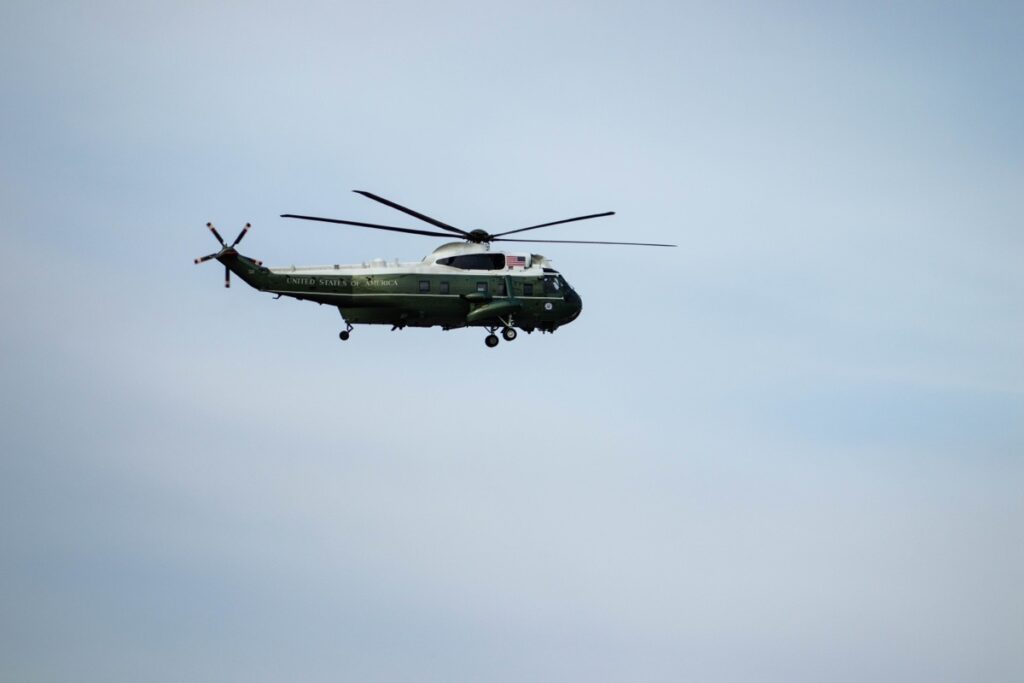
Air traffic controllers and Marine One pilots had met just one week before a Aug. 4 safety incident at Ronald Reagan Washington National Airport to address known communication failures between them — and the backup method they agreed on during that meeting also failed on the day of the event, according to the NTSB’s preliminary report released Thursday.
The incident involved Marine One and a commercial jet being cleared for simultaneous operations in a manner that appeared to violate procedures implemented after the Jan. 29, 2025, midair collision near Reagan that killed 67 people. Officials said the president was not in danger.
Tower audio tells the core of the story. A Marine One pilot radioed the tower that the helicopter was “three minutes to life” — the standard warning required under a 2013 agreement between the FAA and the Pentagon that predates the 2025 crash. The controller reported that transmission as broken and unreadable. When Marine One lifted off minutes later, the controller’s surprise was audible: “Uh, Marine One, you said, uh, you’re proceeding as briefed?” He then gave the helicopter directions and added, “OK, no three minutes, roger, proceed as briefed.”
After the controller alerted Marine One to departing airline traffic, the pilot responded that he had the traffic in sight and declared a momentary delay. The FAA acknowledged the two aircraft briefly came too close before separating. The airliner climbed above the helicopter after the Marine One crew spotted it and paused.



The FAA’s post-2025-crash policy requires all takeoffs and landings at Reagan to halt whenever a helicopter transits on a conflicting route. The communication breakdown meant that policy was not properly applied on Aug. 4.
The communication problems between military helicopter operations and Reagan tower are not new. During congressional hearings following the 2025 midair collision, it was revealed that a dedicated hotline connecting the Pentagon directly to the Reagan tower had been non-functional for more than three years without the FAA detecting the outage. The Aug. 4 incident suggests the fixes put in place since then remain incomplete.
Update (August 28, 2026 at 2:48 AM ET)
- White House construction contributed to radio problems by causing Marine One to shift to a new location during the construction.
- The FAA moved the radio receiver from a neighborhood near the airport to the top of the tower at Reagan to fix the communication problem.
- On Thursday, air traffic controllers at Reagan airport couldn’t hear Marine One and had to ask a support helicopter for help just before takeoff.
- Communication was restored about a minute after the support helicopter was asked to relay information.
- Trump was leaving the White House on Thursday to head to Texas for a Republican National Committee event and present an award to the Artemis II astronauts.
- The alternative communication method agreed upon at the week-before meeting was also unsuccessful on the day of the Aug. 4 incident.
Update (August 28, 2026 at 8:48 AM ET)
- The Marine One crew attempted to give controllers a required three-minute notice of departure at least twice but were hampered by communications issues.
Update (August 28, 2026 at 8:48 AM ET)
- White House construction may have been a factor in the Marine One incident.
Update (August 28, 2026 at 2:48 PM ET)
- White House construction contributed to radio problems by causing the helicopter to shift to a new location during the construction.
- Technicians discovered the root cause was the helicopter’s shift to a new location during construction.
- The FAA moved the radio receiver from a neighborhood near the airport to the top of the tower at Reagan to fix the communication problem.
- On Thursday, air traffic controllers at Reagan airport couldn’t hear Marine One just before takeoff and had to ask a support helicopter to relay information.
- Communication was restored a little over a minute later for the afternoon flight to Joint Base Andrews.
- Since mid-July, Trump’s helicopter has been lifting off from the Ellipse while construction has been ongoing for a new helipad behind the White House.
Update (August 28, 2026 at 8:09 PM ET)
- The aircraft involved was an Envoy Air E-170.
Update (August 29, 2026 at 2:48 AM ET)
- The Marine One crew attempted to give controllers a required three-minute notice of departure at least twice.
- Communications issues hampered the crew’s attempts to notify controllers.
Update (August 29, 2026 at 3:48 PM ET)
- White House construction, including the relocation of helicopter flights from the South Lawn to the Ellipse in May, contributed to the incident.
- The helipad relocation from the South Lawn to the Ellipse was due to construction work including Trump’s new ballroom planned to replace the East Wing.
- Marine One crew attempted at least twice to radio controllers but were unable to do so.
- The backup communication method through Joint Base Anacostia-Bolling also failed on August 4.
- The FAA relocated an antenna and changed procedure following the incident.
- Air traffic controllers lost contact with Marine One briefly on Thursday as Trump was heading to an event in Texas, with communication quickly restored and no safety issue.
- The separation between Marine One and the Embraer was 0.82 nautical miles laterally and 700 feet vertically.
Update (August 29, 2026 at 3:48 PM ET)
- The temporary Ellipse site relocation in July, caused by White House helipad closure since May for UFC Freedom 250 arena construction, was identified as a factor in the incident.
- FAA coverage analysis determined there was not adequate line-of-sight to ensure communications between the radio transmitter/receiver site and The Ellipse.
- The helicopter’s first attempted three-minute warning was not received by National Airport’s air traffic control tower.
- The helicopter attempted to relay the three-minute warning through the helicopter facility at Joint Base Anacostia-Bolling, which was also unsuccessful.
- The closest approach was 0.82 miles laterally and about 700 feet vertically.
Update (August 29, 2026 at 3:48 PM ET)
- The helicopter and plane were approximately eight-tenths of a mile apart laterally and about 700 feet apart vertically at their closest point.
- Marine One pilots attempted to relay their three-minute warning call through the helicopter facility at Joint Base Anacostia-Bolling, but that relay was also unsuccessful.
- The crew of the Envoy Air flight received a traffic warning from their collision avoidance system right after takeoff but never saw the helicopter.
Update (August 29, 2026 at 4:18 PM ET)
- White House construction, specifically the relocation of helicopter flights from the South Lawn to the Ellipse in May due to construction projects including a new ballroom and helipad, was identified as a contributing factor to the incident.
- The NTSB found that Marine One crew attempted at least twice to radio controllers to give the required notice but were unable to do so.
- Marine One and the Embraer were separated by 0.82 nautical miles laterally and 700 feet vertically at one point.
- The FAA relocated an antenna and changed procedures following the incident, with checks after the relocation showing no subsequent communication issues.
- Air traffic controllers lost contact with Marine One briefly on Thursday as Trump was heading to Texas, though communication was quickly restored with no safety issue.
- Marine One took off at 2:33 p.m. and the passenger jet one minute later.