






































Fourth Quarter 2025
- Acquired Spirit AeroSystems in December underscoring commitment to safety, quality, and production stability
- Revenue increased to $23.9 billion primarily reflecting 160 commercial deliveries
- Earnings reflects $9.6 billion gain on sale associated with closing the Digital Aviation Solutions transaction
- Operating cash flow of $1.3 billion and free cash flow (non-GAAP)* of $0.4 billion
Full Year 2025
- Revenue of $89.5 billion and 600 commercial deliveries reflect the highest annual totals since 2018
- Total company backlog grew to a record $682 billion, including over 6,100 commercial airplanes
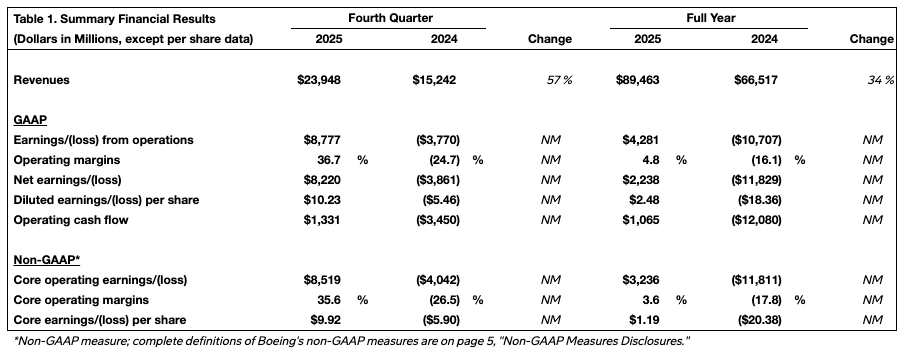
The Boeing Company [NYSE: BA] recorded fourth quarter revenue of $23.9 billion, reflecting improved operational performance and higher commercial delivery volume. GAAP earnings per share of $10.23 and core earnings per share (non-GAAP)* of $9.92 primarily reflect a $9.6 billion gain on sale associated with closing the Digital Aviation Solutions transaction, which increased earnings per share by $11.83. The company reported operating cash flow of $1.3 billion and free cash flow (non-GAAP)* of $0.4 billion. Total company backlog grew to a record $682 billion primarily reflecting 1,173 Commercial Airplanes net orders in the year, with all three segments at record levels.
“We made significant progress on our recovery in 2025 and have set the foundation to keep our momentum going in the year ahead,” said Kelly Ortberg, Boeing president and chief executive officer. “We completed the acquisition of Spirit AeroSystems and the sale of portions of the Digital Aviation Solutions business and remain focused on promoting stable operations, completing our development programs, rebuilding trust with our stakeholders, and fully restoring Boeing to the iconic company we all know it can be.”






Operating cash flow was $1.3 billion in the quarter reflecting higher commercial deliveries, as well as working capital timing. Additions to property, plant and equipment primarily reflects higher investments in Charleston and Saint Louis sites.

Cash and investments in marketable securities totaled $29.4 billion, compared to $23.0 billion at the beginning of the quarter, primarily driven by $10.6 billion in proceeds associated with closing the Digital Aviation Solutions transaction and free cash flow generated in the quarter, partially offset by debt repayment associated with the acquisition of Spirit AeroSystems. Debt was $54.1 billion, up from $53.4 billion at the beginning of the quarter, primarily reflecting the acquisition of Spirit AeroSystems. The company maintains access to credit facilities of $10.0 billion, which remain undrawn.
Caution Concerning Forward-Looking Statements
This press release contains “forward-looking statements” within the meaning of the Private Securities Litigation Reform Act of 1995. Words such as “may,” “will,” “should,” “expects,” “intends,” “projects,” “plans,” “believes,” “estimates,” “targets,” “anticipates,” and other similar words or expressions, or the negative thereof, generally can be used to help identify these forward-looking statements. Examples of forward-looking statements include statements relating to our future financial condition and operating results, industry projections and outlooks, plans, objectives and goals, as well as any other statement that does not directly relate to any historical or current fact. Forward-looking statements are based on expectations and assumptions that we believe to be reasonable when made, but that may not prove to be accurate.
These statements are not guarantees and are subject to risks, uncertainties, and changes in circumstances that are difficult to predict. Many factors could cause actual results to differ materially and adversely from these forward-looking statements. Among these factors are risks related to: (1) general conditions in the economy and our industry, including those due to regulatory changes; (2) our reliance on our commercial airline customers; (3) the overall health of our aircraft production system, production quality issues, commercial airplane production rates, our ability to successfully develop and certify new aircraft or new derivative aircraft, and the ability of our aircraft to meet stringent performance and reliability standards; (4) changing budget and appropriation levels and acquisition priorities of the U.S. government, as well as significant delays in U.S. government appropriations; (5) our dependence on our subcontractors and suppliers, as well as the availability of highly skilled labor and raw materials; (6) work stoppages or other labor disruptions; (7) competition within our markets; (8) our non-U.S. operations and sales to non-U.S. customers, including tariffs, trade restrictions and government actions; (9) changes in accounting estimates; (10) realizing the anticipated benefits of mergers, acquisitions, joint ventures/strategic alliances or divestitures, including anticipated synergies and quality improvements related to our acquisition of Spirit AeroSystems Holdings, Inc.; (11) our dependence on U.S. government contracts; (12) our reliance on fixed-price contracts; (13) our reliance on cost-type contracts; (14) contracts that include in-orbit incentive payments; (15) management of a complex, global IT infrastructure; (16) compromised or unauthorized access to our, our customers’ and/or our suppliers’ information and systems; (17) potential business disruptions, including threats to physical security or our information technology systems, extreme weather (including effects of climate change) or other acts of nature, and pandemics or other public health crises; (18) potential adverse developments in new or pending litigation and/or government inquiries or investigations; (19) potential environmental liabilities; (20) effects of climate change and legal, regulatory or market responses to such change; (21) credit rating agency actions and our ability to effectively manage our liquidity; (22) substantial pension and other postretirement benefit obligations; (23) the adequacy of our insurance coverage; (24) the dilutive effect of future issuances of our common stock; and (25) the preferential treatment of our 6.00% mandatory convertible preferred stock.
Additional information concerning these and other factors can be found in our filings with the Securities and Exchange Commission, including our most recent Annual Report on Form 10-K, Quarterly Reports on Form 10-Q and Current Reports on Form 8-K. Any forward-looking statement speaks only as of the date on which it is made, and we assume no obligation to update or revise any forward-looking statement, whether as a result of new information, future events, or otherwise, except as required by law.