














































Folks, it’s February and time for a few announcements. First of all, by the time you read this, The Business Aviation Book: Leading Operational Excellence will be out and available. It was released for sale on January 31 of this year and is available in hardback or electronic versions. If you’d like a hardback copy that is signed by Mike Nichols and me, you can order it from my website:
chrisbroyhillbooks.com. You can also download the eBook version from my website as well. Hardback and eBook versions will also be available on Amazon.com.
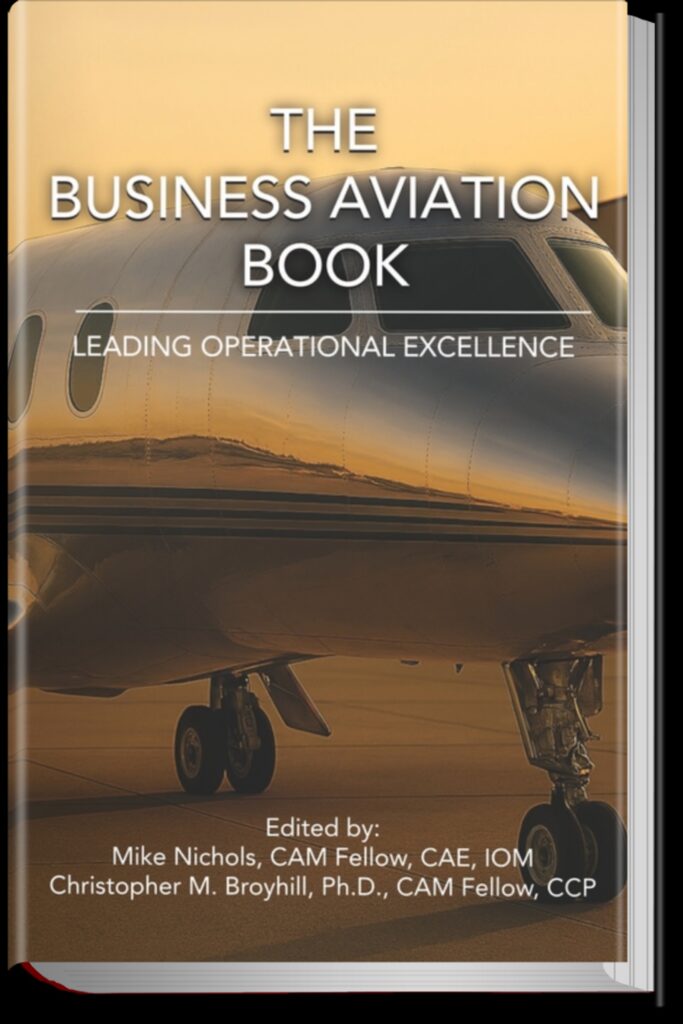
Here’s the pitch from the back cover: The Business Aviation Book: Leading Operational Excellence is a one-of-kind, groundbreaking work. It provides the industry’s most complete single-source reference for the knowledge required to operate an aviation department. Edited by two industry thought leaders, Mike Nichols, CAM Fellow, CAE, IOM and Christopher M. Broyhill, Ph.D., CAM Fellow, CCP. The Business Aviation Book covers 34 topics with material written by 24 business aviation experts. The subject areas include:
- Leadership
- People Management
- Communications
- Structuring Strategies
- Safety and Security
- Risk Management
- Maintenance Management
- Environmental Sustainability
- Aircraft Operations
- Money Matters
The Business Aviation Book has been designed to be read, cover to cover, or consulted on an as-needed basis when questions arise. Each chapter covers its topic in detail and provides a list of references for further research. Some chapters also include operational exercises to generate discussion on the topic presented. Whether you’re a current business aviation leader or an aspiring one, The Business Aviation Book: Leading Operational Excellence belongs in your library!


As you may or may not know, I built and ran a flight department for a Fortune 100 corporation many years ago. I was Chief Pilot for another Fortune 100 company when I was hired, and as I transitioned to the Aviation Director position, I remember thinking I was up to the task and possessed all the knowledge I needed to perform it. I could not have been more wrong. There were huge gaps in my knowledge, gaps which a resource like The Business Aviation Book could have helped fill. I recalled that experience while we were in the final stages of working with my formatting person to get the book ready for printing and thinking what a resource the book would be to our industry. But then another thought—more of an epiphany really—occurred to me. What if there were a forum where, in addition to the subjects covered in the book, other topics that were unique to flight departments and business flight operations, could be covered? A forum where topics like leadership, culture, safety, and accountability would be discussed. Perhaps a place that would allow the industry to explore some of the more sensitive areas in a manner that was both safe and inspirational.
And with that, the idea for a new podcast was born. Starting sometime in March, The Flight Department Show will debut on the normal array of podcast channels and on YouTube. We’ll do two podcasts per month and interview the individual authors of the chapters of The Business Aviation Book and discuss not only the information in each chapter, but also what inspired the writer of that chapter and why they think that information is important. We’ll also interview flight department leaders, decision makers, thought leaders and individuals. More to come!
One final random thought. As of this writing, I’ve completed more deep-dive compensation studies than I can count—somewhere north of 500. In many cases, my clients for these studies are HR compensation professionals who view the data I generate as indispensable in their data toolkit. I’ve generated pay scales for multiple national management companies as well as several smaller management companies. The AirComp Calculator itself has generated thousands of reports for aviation managers and individual professionals. Nearly on a daily basis, I receive emails wherein the writer expresses their appreciation for the accuracy of the data and the transparency it provides for them.
But every once in a while, I encounter data-deniers. After nearly a decade in the compensation consulting business, this phenomenon has occurred only a handful of times. The deniers are never HR compensation personnel. They are always aviation managers, executives or principals. The remarks I hear from these people after they examine AirComp Calculator data sounds something like “We’re just not seeing that in the market.” or “Nobody is paying at that level,” or “Our data doesn’t show that.” I typically respond in a very diplomatic manner and explain my methodology (again) with as much detail as I can without revealing certain proprietary elements. I emphasize that my source data comes from surveys which provide objective data about the personnel market and that my methodology breaks the data down, ages it, and regionalizes it using a non-biased scientific process that has been repeatedly validated. Sometimes, that explanation can change a denier’s mind, but it most cases, it does not. The reason is simple. The deniers already have their minds made up and refuse to entertain data that challenges their viewpoint. In every case where this phenomenon has occurred, it is a function of the denier wanting to pay at a lower level than AirComp Calculator data generates. To put it more bluntly, they’re too cheap to pay at market rates and are trying to justify it with the own version of the market data. I’d argue that this situation is similar to bringing your own data to a CPA and trying to win an argument about deductions and tax rates. Sure, you might prevail in the discussion, but it won’t stop the IRS from auditing you.
So, my words of advice here are simple. If you purchase AirComp Calculator data and present it to someone who refuses to take that data into account and then tries to justify lower compensation because of their own data, you’re dealing with someone who has an agenda of their own, and that probably doesn’t include the welfare of their people.
Podcast – The Flight Department Show
“Data doesn’t match what we’re seeing”