

















From Freedom One to Imua One, there’s nothing quite as spectacular as seeing one of Southwest’s specialty planes. Each one is more than an aircraft—it’s a flying work of art. But as I watched these planes taxi by, I found myself wondering: How do these masterpieces actually come to life?
To find the answer, I began with Eric Daniels, a Consultant on Southwest’s Creative Studio Team and someone who knows a thing or two about turning bold ideas into flying realities. Eric’s journey with Southwest began in 2008 through the Company’s college internship program—a starting point that would eventually lead him to design some of the most visible creative work in the sky.
Over his nearly 15 years with Southwest, Eric has built an impressive portfolio.
“From designing a street sign for Herb Kelleher Way that leads into Dallas Love Field Airport and Southwest’s current Employee badge design, to the new official Southwest specialty aircraft trading cards, I’ve been able to work on some incredible projects,” Eric shared. “But by far, the most exciting is working on the biggest canvas Southwest offers—a Boeing 737.”

For Eric, that canvas first came into sharp focus in 2017, when Southwest partnered with Disney / Pixar for the premiere of Coco.
As part of the promotion, a Southwest aircraft would feature a vibrant Coco logo and artwork inspired by the film. The stakes were high. The assignment fell on Southwest’s in‑house Creative Services Team—of which Eric’s a part—to come up with a concept to celebrate everyone involved. Once Eric settled on a final design, it then had to be approved by the film’s producers and directors, as well as Pixar’s chief creative director.
“When the concept was approved to be emblazoned on the side of a Southwest 737‑700,” Eric shared. “The excitement was instant—but so was the weight of responsibility. Designing something on a screen is one thing. Seeing it scaled up on an aircraft, viewed by millions, is something else entirely.”
That’s where experience entered the picture.
On the first day of decaling for the Coco aircraft, Eric met Roger Stakes, founder of Solo Graphix—the premier aviation markings specialist. Almost immediately, Roger sensed Eric’s nerves—understandable, given this was Eric’s first time designing a large‑scale aircraft decal. With calm confidence, Roger offered reassurance: “I’ve done tons of these … we’ve got this.”
Those eight words set the tone for what would become a long‑standing creative partnership. Over the past eight years, Eric and Roger have collaborated on six aircraft decal and paint designs, combining imagination with precision every step of the way.
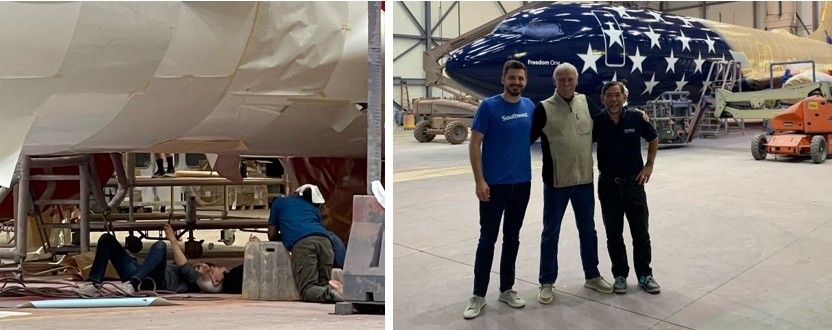
“Roger is one of the most interesting and innovative people I’ve ever met,” Eric said. “He’s built Solo Graphix from a small business run out of his garage into a leader in aircraft branding and design.”
Roger’s path was anything but conventional.
With backgrounds in both engineering and fine arts, he began his career in construction during the 1980s, painting corporate heliports on offshore oil platforms. When the oil industry declined mid‑decade, he pivoted—this time into software development.
That pivot proved pivotal.
In 1988, Roger recognized an opportunity to unite his passions for art, engineering, and technology. “A large helicopter company came to me with a problem,” he recalled. “They needed a more efficient way to rebrand their aircraft. Their process took four people an entire month to hand‑layout logos for just two aircraft.”
Roger responded with innovation, developing a technology‑driven stenciling process that allowed designs to be printed in sections and applied with precision—eliminating the need for time‑consuming hand layouts.
“The shift to stenciling increased productivity by 200%,” Roger said. “That’s when I knew I was onto something.”
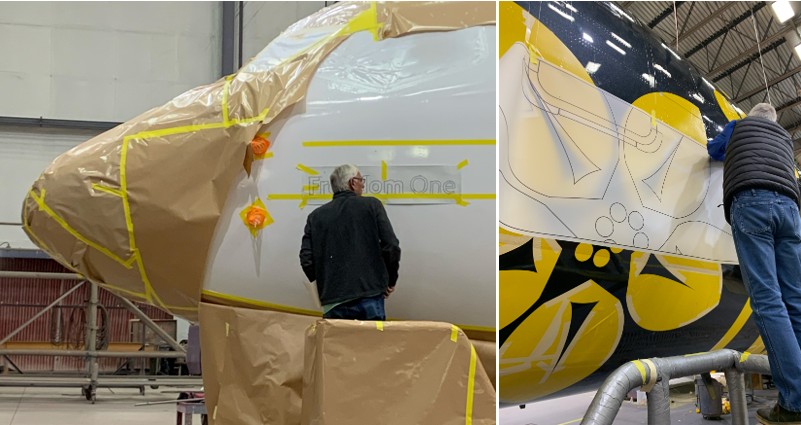
Word traveled fast. In 1989, Continental Airlines reached out for help rebranding its livery. Roger’s process shaved three full days of hangar time per aircraft—an efficiency that quickly caught the industry’s attention. Before long, Solo Graphix was working with most major airlines and aviation companies.
“I feel like everything in my past led me here,” Roger reflected. “It gave me the knowledge to rethink how aircraft branding could—and should—be done.”
Like most great works of art, it all begins with inspiration.
When Southwest sets out to create a specialty plane, the first step is defining what the design needs to accomplish. Should it inspire? Entertain? Feel playful—or serve a promotional purpose? Answering these questions helps shape the story the aircraft will ultimately tell.
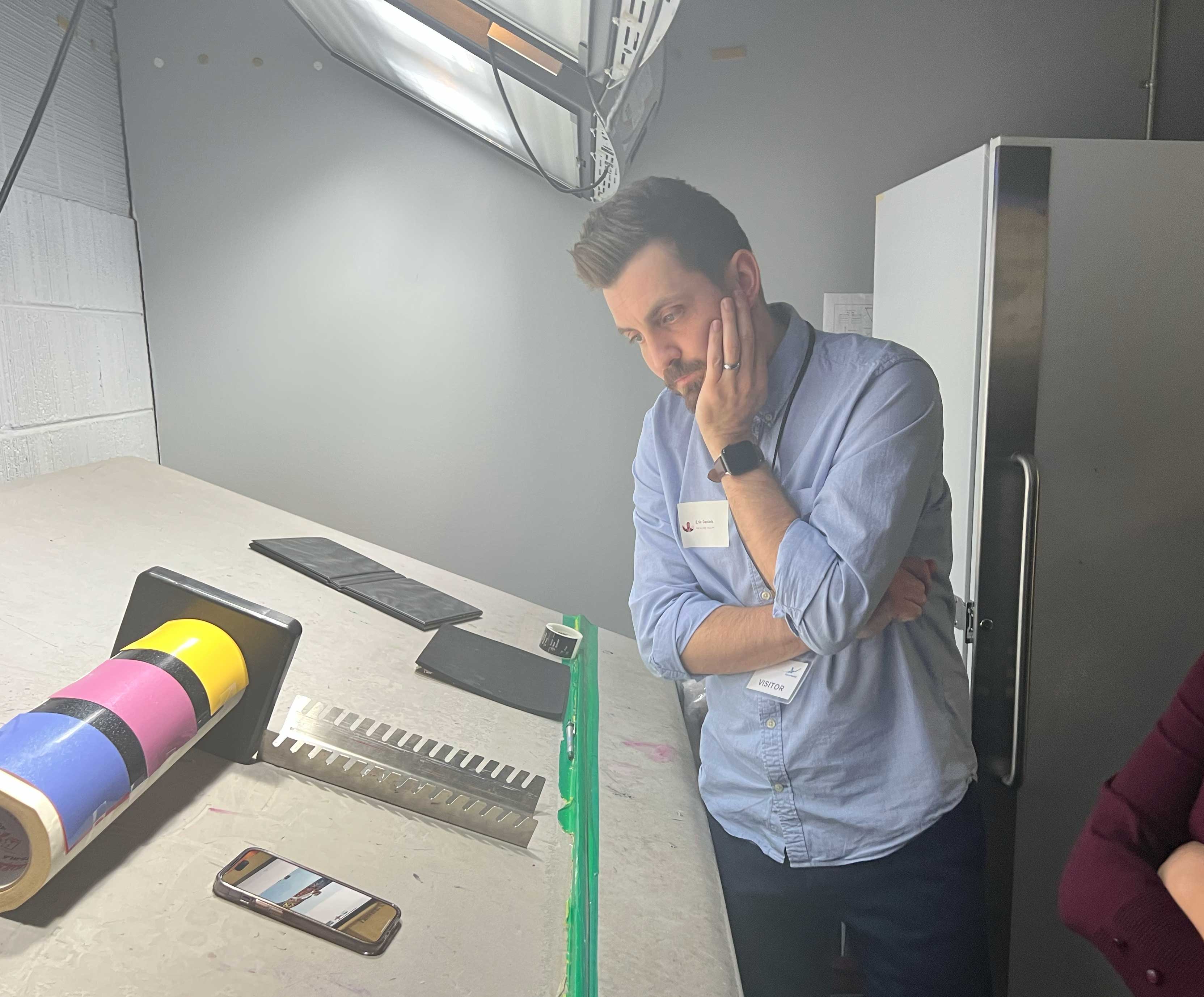
“When I sit down to start designing a concept for a specialty plane, I begin with the project brief to understand the look and feel Southwest is aiming for,” Eric explained. “From there, I create a series of renderings that are presented to internal stakeholders, who collaborate to refine the ideas and ultimately select a final design.”
Once the concept is finalized, the process shifts from imagination to engineering. The approved rendering is sent to Solo Graphix, where it’s translated into a detailed engineering drawing that maps exactly how the design will be brought to life on a three‑dimensional aircraft. That schematic is then reviewed by Southwest’s Engineering Team, and once approved, the aircraft is officially scheduled for paint or decaling.
The Newest Members of Southwest’s Specialty Fleet
On April 27, Southwest unveiled its newest specialty planes—Independence One and Liberty One—in honor of America’s 250th anniversary and to help tell the story of the United States of America.
“As Southwest celebrates our 55th year, and our nation celebrates 250, we wanted to mark this moment in a way that reflects who we are, where we’ve been, and where we’re headed,” said Southwest CEO Bob Jordan at the aircraft unveiling. “When we thought about how to do that, no words from our founding documents were more fitting than life, liberty, and the pursuit of happiness. From the day Southwest first took to the skies, those aspirations have defined who we are as a Company.”
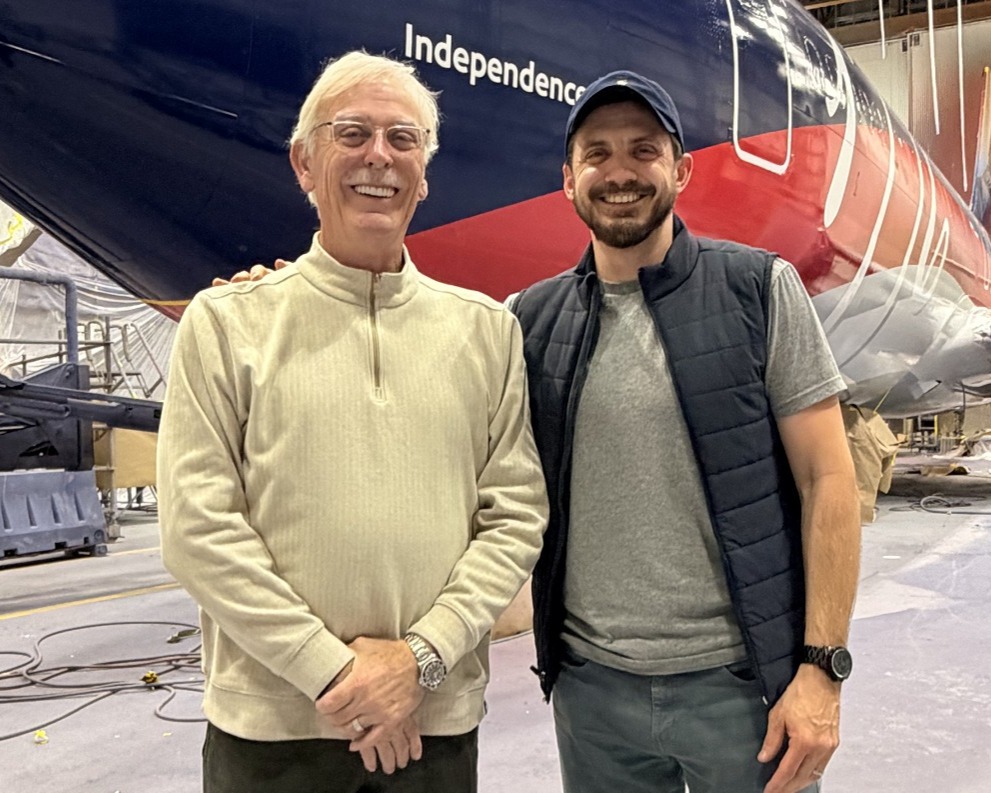
Eric took this heart.
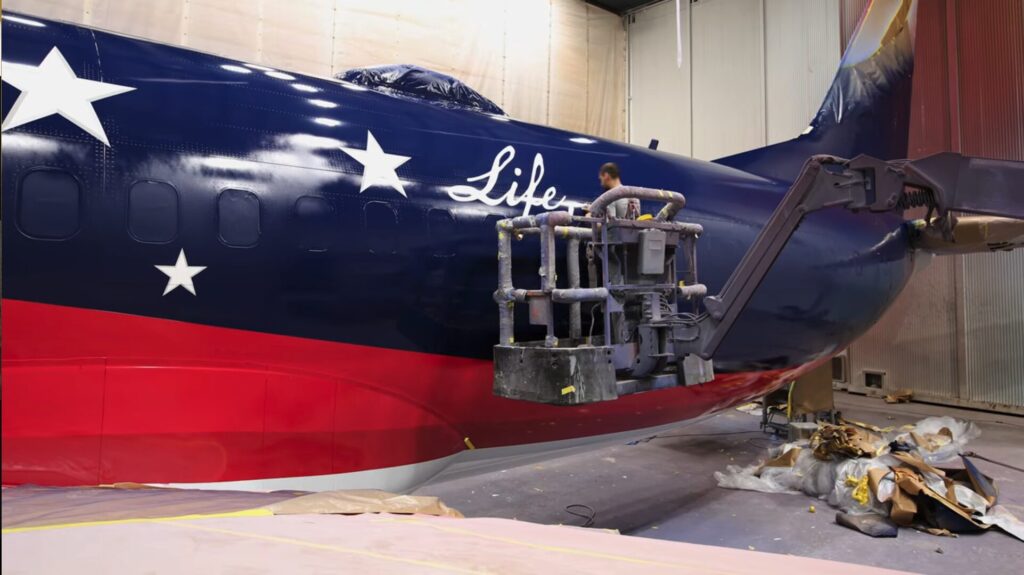
“When designing the elements for Independence One, I wanted to incorporate key symbols from American history,” he shared. “Built around a red, white, and blue paint scheme, 1776 is emblazoned across the fuselage in quill script, and one of the Declaration of Independence’s three inalienable rights—Life, Liberty, and the Pursuit of Happiness—is prominently featured. In addition, a circle of stars on each engine cowling pays homage to the original Betsy Ross flag.”
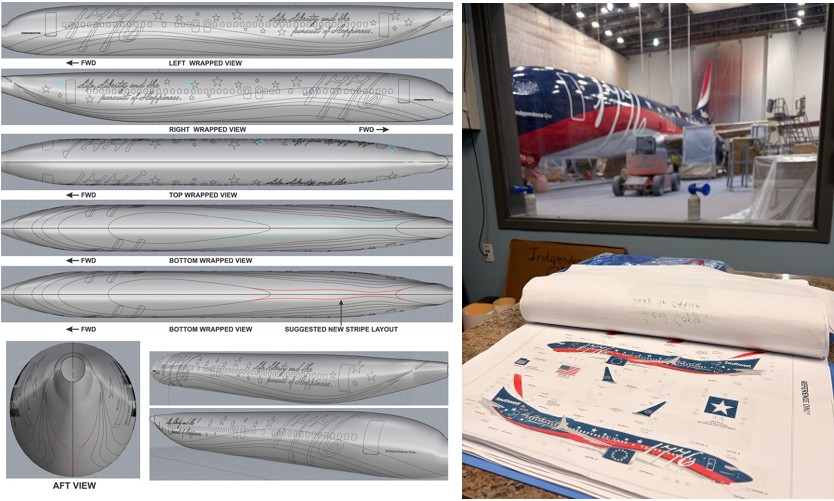
Of course, Eric once again partnered with Roger to bring this aircraft to life. Check out how Independence One came to life:
Thanks to collaborations like this, Southwest’s specialty planes continue to soar—transforming aircraft into storytelling canvases, one bold design at a time.