




















































Recently, I was asked to speak to the National Safety Roundtable, an event that occurs the day before the Flight Safety Foundation’s annual Business Aviation Safety Seminar. The gentleman who asked me to speak is a former client who sits on the board, and he was keenly interested in my ideas on the correlation between compensation and safety. I agreed to speak on that topic, thinking that I could easily generate a presentation that would capture those ideas in just a few minutes. Instead, I had a bit of an epiphany—an epiphany dealing with the relationship between organizational culture, compensation, and safety. Let me walk you through it.
First, let’s look at the metaphor I’ve been using to capture the relationship between organizational culture, compensation, and leadership since I’ve been speaking on those subjects.
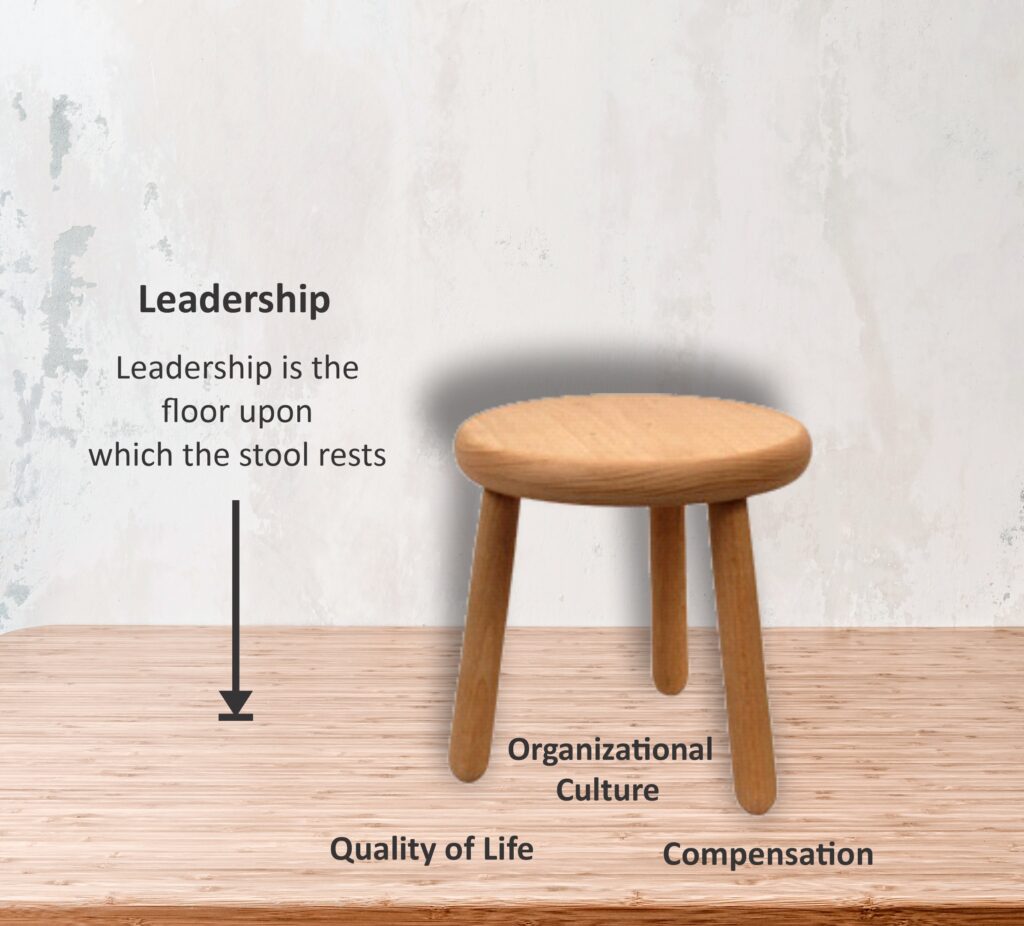
Makes sense, right? If personnel retention is the stool, then organizational culture, quality of life, and compensation are the legs, and the whole thing rests on the foundation of leadership. For years, I have believed this picture captures the relationship between these areas. But, as I thought through that relationship, especially as I focused on the compensation piece, a different relationship emerged.




Organizational Culture
To start the discussion, let’s examine the topic of organizational culture. (I would strongly argue that if someone aspires to lead an organization, let alone an aviation organization, a knowledge of how organizational culture works is crucial.) While entire books have been written on organizational culture, perhaps the best academic definition comes from Edgar Schein:
The culture of a group can be defined as the accumulated shared learning of that group as it solves its problems of external adaptation and internal integration; which has worked well enough to be considered valid and, therefore, to be taught to new members as the correct way to perceive, think, feel, and behave in relation to those problems. This accumulated learning is a pattern or system of beliefs, values, and behavioral norms that come to be taken for granted as basic assumptions and eventually drop out of awareness (Schein, 2017, p. 6).
The working definition is simply: “The way we do things around here.” But what does that look like?
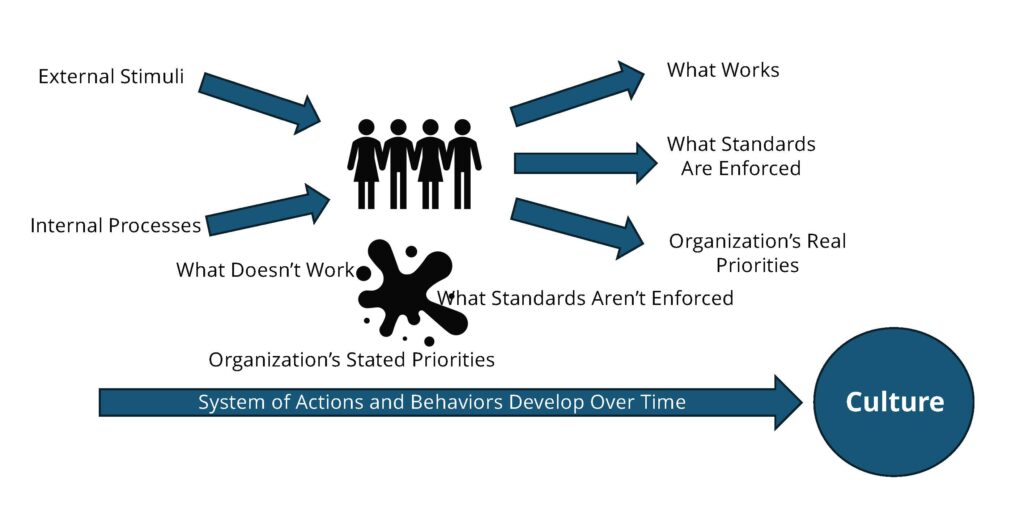
Organizational culture is formed based on what works, what standards are enforced, and what the organization’s real priorities are. You’ll notice that there is no qualification of whether those elements are good or bad. That’s irrelevant. It’s about what works, what people actually do, what they have learned to do within the context of the organization. Sometimes, those elements can be good, and they can make the organization perform better. Other times, those elements can be bad, or even toxic, and destroy the organization.
How is an organization guided in the decision of what works? Well, as you might imagine, it’s all about leadership.
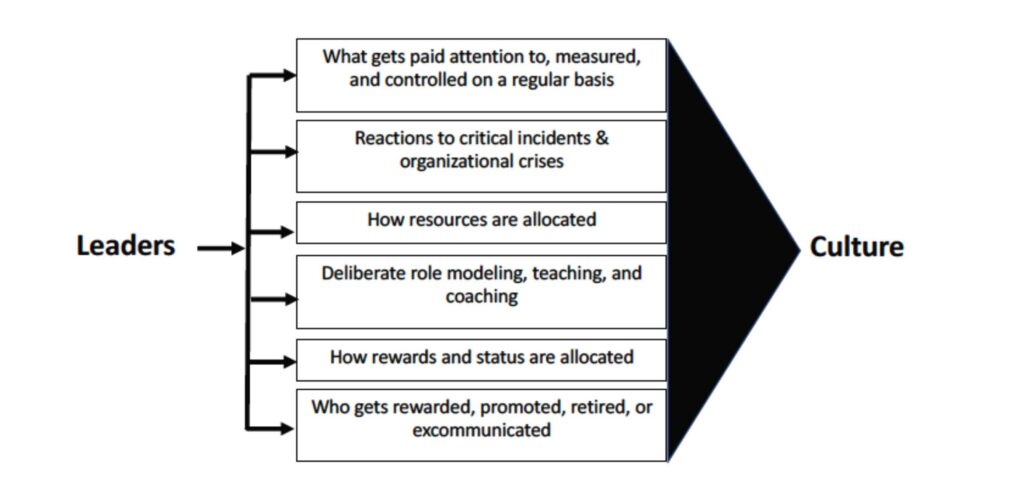
Schein says, “Culture creation and management are the essence of leadership and make you realize that leadership and culture are two sides of the same coin” (Schein, 2010, p. 3). We see that manifested in Figure 3. In a leader’s day-to-day actions and words, organizational culture is formed, reinforced, and inculcated. If you’re in a leadership position, your subordinates are watching everything you do, and they are listening to everything you say.
Safety Culture and Retention
From organizational culture, we move to safety culture. Since many of the elements of safety culture are embedded in organizational culture, an organization’s safety culture directly reflects its overall culture (Broyhill, 2016). And here’s where the retention piece fits into the puzzle. A deliberate effort to retain personnel not only reflects a healthy organizational culture but also reflects a healthy safety culture. Why is retention a key element? Because keeping the same people working together in an organization reduces variables within that operation. The interactions between personnel remain constant because the team knows how to work together within the organization’s culture. Conversely, personnel turnover introduces variables into the organizational culture which can disrupt it, adversely affecting the safety culture embedded in it.
Compensation as a Cultural Indicator
The decision not to pay competitive compensation rarely occurs in isolation. In fact, when we examine the top excuses organizations use to justify not increasing compensation (excuses we’ve discussed in previous articles), we can see that they stem from leadership/cultural issues.
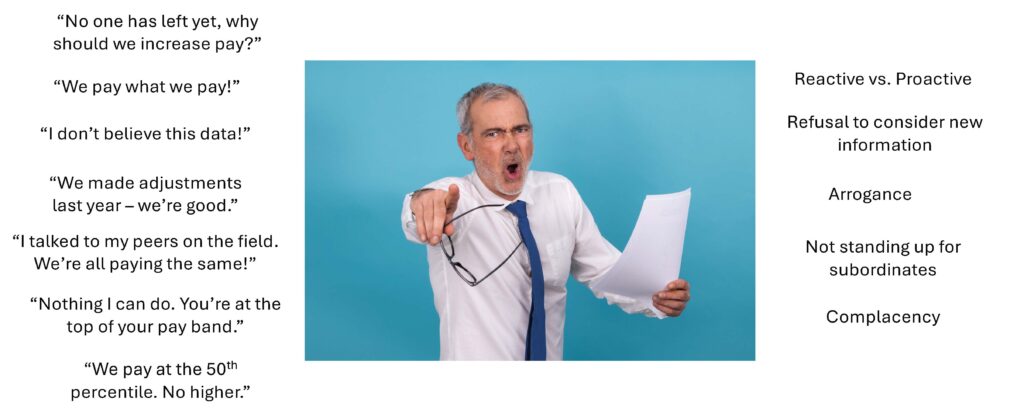
Further, an organization which has a cultural issue with paying competitive compensation will probably have a cultural issue with paying more for safety-related programs like safety education, IS-BAO, FOQA, etc. Put bluntly, cheap organizations are usually cheap across the board, not just in one area. FlightSafety International has maintained for years that “the best safety device in any aircraft is a well-trained pilot.” I would add that “the best safety investment you can make is to retain your personnel by paying them competitively.”
You might be asking where the epiphany is in all of this. That is a function of the figure below.
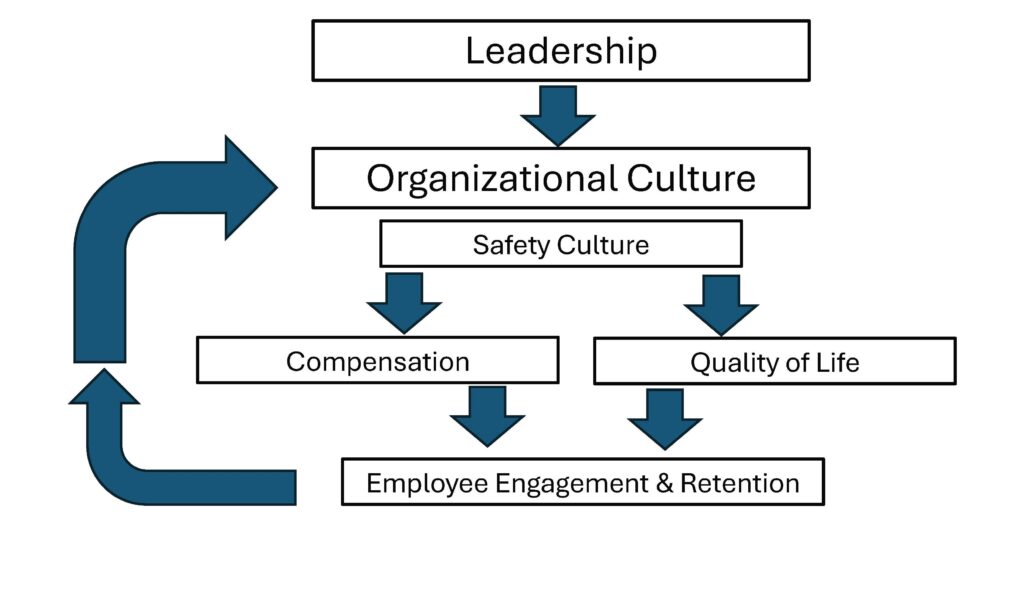
What dawned on me as I put these thoughts together (granted, they could do with a little refinement) is that my three-legged stool model did not accurately reflect the way the retention equation works. That reality is reflected in Figure 5. Leadership drives the organizational culture and the safety culture, that, in turn, drive compensation and quality of life. Compensation and quality of life drive employee engagement and retention, which directly affect the organizational and safety cultures. If the retention is good, the organizational culture remains stable. If retention is bad, the organizational culture, and the safety culture with it, are degraded.
What’s the takeaway from all of this? When a leader/an organization is setting priorities for safety dollars, the first investment, in fact, the best investment, is simple. Pay people competitively. The rest will take care of itself.
Bibliography
Broyhill, C. (2016). The Effects of IS-BAO Implementation and Leadership Performance on Safety Culture in Business Aviation Flight Operations. Daytona Beach: Embry-Riddle Aeronautical University.
Schein, E. (2010). Organizational Culture and Leadership. San Francisco: John Wiley & Sons.
Schein, E. (2017). Organizational Culture and Leadership. Hoboken, N.J. : John Wiley & Sons.