























































No doubt winter is here as pilots grapple with environmental and weather-related threats related to icing. In this article, I provide some clarification on different types of temperatures and the importance of reporting the correct temperature while supplying a pilot weather report (PIREP).
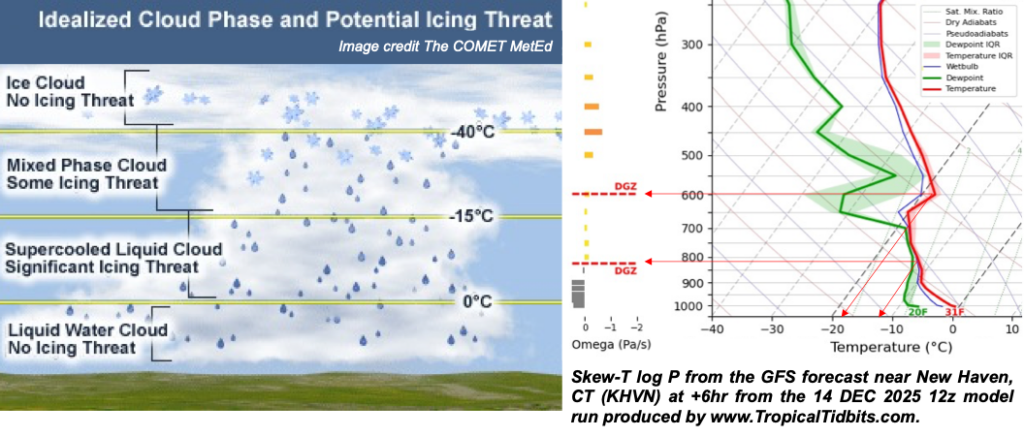
PIREPS enhance the situational awareness of pilots and air traffic control (ATC) and contribute to the overall safety of flight. These reports are used to make important decisions such as final cruise altitude, re-routes, speeds, and of course the seat belt sign. When ATC requests, or pilots supply a PIREP with icing conditions reported, ATC frequently requests a temperature report if this information was omitted from the PIREP. The necessity for a temperature report in a PIREP describing icing conditions helps ATC and other pilots operating in the vicinity to exercise caution and determine the possible severity of the icing threat. Recall, the severity of the icing threat (with some exemptions such as ice-crystal icing or supercooled large drops [SLD] in cumulus cloud tops) is highest in the temperature ranges between 0 and -20°C. These temperature ranges also correspond to the dendritic growth zone (DGZ). Meteorologists analyze the DGZ to accurately forecast the type and nature of precipitation (e.g., rain, freezing rain, mixed precipitation, liquate to snow ratio, i.e., fluffy snow vs. wet snow). From an aircraft icing prospective, the altitudes associated with the DGZ correspond to mixed-phase clouds and riming i.e., dendrites encounter SLD and grow into large, dense “rimed” crystals or aggregates (graupel/rime ice) and stick to aircraft surfaces.
Information from a PIREP such as location, altitude, temperature, and type/intensity of icing are used to build a real-time weather picture, issue warnings (e.g., Significant Meteorological Information-SIGMETs), and provide timely information to other aircraft in the vicinity. Accurate temperature reported from a PIREP is a primary factor in determining the altitude, severity, and type of icing conditions. In turn, this assists pilots and ATC to manage the threat icing poses to flight safety.
On a concerning note however, a common error associated with PIREP temperature reports are pilots incorrectly reporting Total Air Temperature (TAT) instead of Static Air Temperature (SAT). Outside Air Temperature (OAT) may be reported in a PIREP by low-speed aircraft e.g., helicopters and propeller aircraft. The implications of this error include misleading other pilots, ATC, and weather forecasters about the actual OAT, freezing level, and the potential for ice accumulation. PIREPs are also crucial for verifying and improving weather models. Inaccurately reporting TAT instead of OAT or SAT results in data inconsistency and hinders forecast verification.




What are OAT, SAT and TAT?
Outside Air Temperature (OAT): Temperature of undisturbed air as measured by a thermometer. As airspeed increases, an OAT probe is heated due to molecular friction and compression. This will result in an inaccurately high temperature measurement.
Static air temperature (SAT) is calculated from TAT by considering the temperature rise associated with high-speed flight, i.e., Ram Rise (RR). RR is attributable to compression (adiabatic heating) and conversion of kinetic energy to internal energy as air molecules are brought to rest by the TAT probe during high-speed flight. SAT is the actual air temperature, also referred to as true outside temperature or ambient temperature. SAT = TAT – RR.
Total Air Temperature (TAT) is the temperature measure by the TAT probe after bringing the air to rest relative to the aircraft. This is the temperature the aircraft skin “feels” and is useful in determining the risk of airframe icing (e.g., wings, engine nacelles, and interior fuel tank). Therefore, it should come as no surprise that engine anti-ice is turned ON at TAT
in visible moisture despite being above freezing. TAT = SAT + RR. TAT is the starting point for the air data computer (ADC) to compute SAT and other variables essential to determine aircraft performance and navigation. A simplified method to determine RR is:
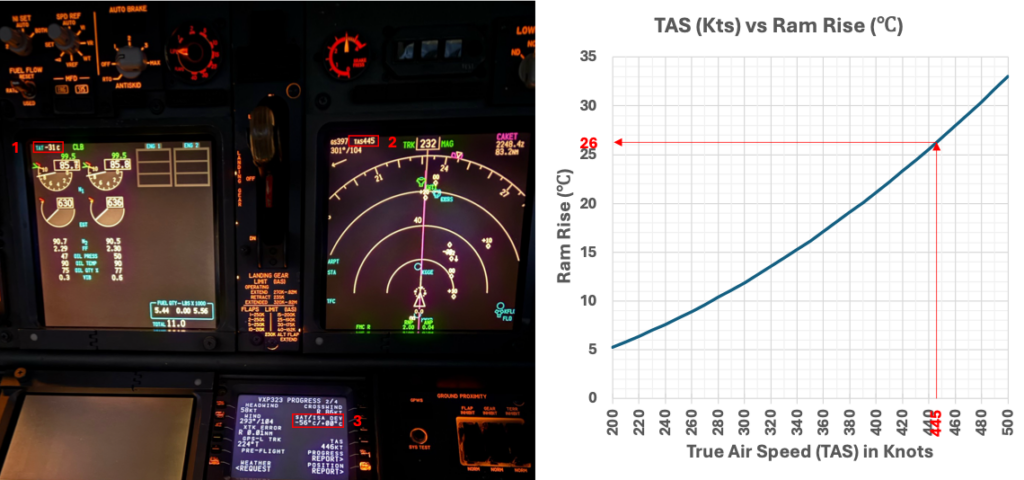
The figure above shows an aircraft TAT probe measuring -31°C. At a TAS of 445 knots, the RR is 25°C and the calculated SAT is -56ºC. These numbers are nearly identical when calculated using the simplified method to determine RR that yields 26°C.
| Definition | Importance/Reportable in a PIREP | |
| OAT | The temperature measured by an OAT probe. | May be reported by slow flying aircrafts. Should NOT be used since the OAT probe is subject to increased heating at high speeds. |
| SAT | The actual air temperature, also called true outside/ambient temperature. Calculated as TAT – RR. | Correct temperature to report for meteorological purposes (including PIREPs) and determining the freezing level. |
| TAT | The temperature measured by a TAT probe after bringing the air to rest relative to the aircraft. | Useful for determining the risk of airframe and engine anti-icing requirements. Incorrect to report for PIREPs. |