



































First Quarter Views from the Flight Deck

918
0


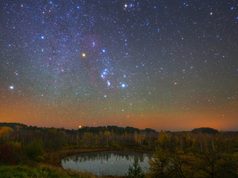
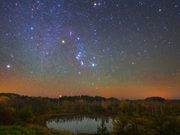
From the flight deck of an aircraft, the northern hemisphere winter (or southern hemisphere’s summer) is the best time to see the features of the night sky. Rising in the east, there are a large number of bright stars. These are the stars of the winter constellations, Taurus/The Bull, Orion/The Hunter, Gemini/The Twins, Auriga the Charioteer, and the two dog constellations —Canis Major and Canis Minor.

During the northern winter, the night sky takes on a spectacular beauty all its own and from an aircraft the clarity of the sky is quite spectacular owed to high altitudes and very low temperatures.

Of the thirty brightest stars visible in the night sky, fifteen of these can be seen during the early part of the year. Twelve of these are visible in our winter skies, and three in the spring sky which will be seen prior to sunrise. This is why we believe that the northern winter and spring sky is the best time of the year for stargazing. The reality is that there are simply a larger number of brighter stars in this area of the sky—regardless of when and where you are viewing them. When you look skywards in the evening sky, look in all directions before gazing east. You’ll notice the number of very bright stars visible in this part of the sky is quite the contrast.

The winter constellations riser early in winter evenings in the east. Most noticeable is a group of stars known as the Pleiades—also known as the Seven Sisters. The group looks like a fuzzy patch in the sky to the naked eye. However, a pair of binoculars shows them as a tightly knit group of many stars, seven of which are brighter than the others.


                   The Winter sky – Looking south around 23:00 hrs              |                   The bright stars and winter hexagon are shown in red

 Following the stars of Taurus into the winter sky are the bright stars of the constellation Orion/The Hunter. Orion is one of the most spectacular constellations in the whole night sky. There are three bright stars within Orion in a line sloping up from left to right. These three stars are known as Orion’s belt. Following the belt upwards to the right, you will come to the star Aldebaran in Taurus. If you follow this line further upwards, you come to the Pleiades star cluster.

  M45- The Pleiades (or Seven Sisters).
The badge on a Subaru car

The annual (or heliacal) rising of the Pleiades coincides with the yearly flooding of the Nile, which was so important all those years ago. This annual flooding was thought to have been caused by the weeping of the seven sisters in the heavens mourning the loss of a sibling. A more recent interpretation is from the car manufacturer Subaru. They have a badge on the front of all their cars, representing the Pleiades, but it only shows six stars. The missing seventh star is the car! That’s marketing for you!

If you go back to Orion’s belt, follow the line down to the left. It will lead to a very bright star: Sirius, the brightest star in the night sky. Sirius is often called the “Dog Star” because it is the principal star of the constellation of Canis Major: The Great Dog. Canis Major is one of two dogs in the sky in this part of the sky, the other being Canis Minor: The Little Dog, which is above Sirius and left of Orion.

Orion can also be used as a as a celestial signpost.

On the northern horizon, you will notice that the asterism of the Big Dipper is now on the right of the North Celestial Pole and is standing on its tail or handle. The pointer stars of Dubhe and Merak are now level with or higher than Polaris.

The northern sky – winter at midnight. 
  The northern sky – spring at midnight.

From the flight deck, once you get beyond midnight, the stars of spring (or fall in the southern hemisphere) will be rising in the east. The spring sky does not have as many bright stars as the winter. There are just three compared with twelve. But most of the winter stars will still be visible in the western sky after sunset. Look towards the northeastern horizon, and you will see that the Plough (called the Big Dipper in North America) is almost overhead. Follow the curve of the handle of the Plough/Big Dipper down towards the eastern horizon to a bright star, Arcturus, the brightest star in the constellation of Bootes/The Herdsman. Follow this curve further down and right towards the horizon to the bright star, Spica, the brightest star in the constellation Virgo/The Virgin. To the right and up from Spica is another bright star Regulus, the brightest star in the constellation of Leo/The Lion.


The spring night sky.

SOURCEAero Crew News, January 2026
Previous articleTAT vs. SAT: The Temperature Error that Puts Pilots on Ice
Next articleAviation Goals for 2026
Howard L.G. Parkin MBE. BSc. BEd. FRAS.
Inspired by the space race in the 1960s, Howard has been an enthusiastic astronomer since childhood and has become an accomplished and entertaining speaker on the subject throughout the world. Howard holds a Teachers Certificate, and an Open University BSc in astronomy and earth sciences. Howard has been teaching astronomy at the University College of Man since 1985. He is a founder member, former chairman (2004 to 2014) and is currently the vice-chairman of the Isle of Man Astronomical Society. In July 2013, in recognition of his work in education and outreach, Howard was elected as a fellow of the Royal Astronomical Society, and in 2019 was awarded an honorary BEd degree by Chester University. In 2021, Howard was awarded the British Astronomical Association (BAA) Sir Patrick Moore Award for his work in encouraging popular astronomy. He was presented with the award by the BAA president at their December 2021 meeting. In King Charles III’s New Year Honours list for 2025, Howard was awarded an MBE (Member of the Order of the British Empire) for his for “outstanding services to the understanding of Astronomy and the Manx Community.” In 2009, courtesy of NASA and Manx National Heritage, Howard hosted a uniquely special event when a live link with the International Space Station was set up at the Manx Museum by which Howard and several Manx schoolchildren spoke live for over 40 minutes with U.S. astronaut Nicole Stott. Since retiring in 2012, he delivers regular talks at schools and gives public lectures on various aspects of the subject throughout the Island and the U.K. In recent years, Howard has assisted with the design of numerous special astronomically themed commemorative stamps for Isle of Man (IOM) Post, which have been marketed throughout the world. In 2013, Howard established an astronomy consultancy and promotions company, AstroManx, and through his work, he obtained Dark Skies Discovery status for the Isle of Man; initially for seven sites in 2011, and 19 further sites in 2014, formally leading to the Island being recognised as one of the best places to stargaze in the British Isles. In 2018 Howard became the first resident astronomer for Viking on their cruise ships Viking Orion and Viking Jupiter. Each ship has an onboard Digistar 6 planetarium. In May 2018, Howard travelled to Salt Lake City, Utah to undertake intensive training on the operation of the facilities. Howard's role with Viking also includes writing and delivering iconic lectures on astronomy and the work of NASA. He has now lectured on 45 cruises on 20 different ships throughout the world where his presentations have been acclaimed by guests and for their informative, amusing and educational content, and for his infectious enthusiasm. In 2021, Howard’s first book, Space for Dark Skies, was published that covers the subject of astronomy from his own perspective and is aimed at enthusiasts of any age. In September 2022, Howard was appointed as the DarkSky International (DSI) advocate for the Isle of Man. The DSI Advocate Network is a global community united in its efforts to protect the night from light pollution. For many years now, Howard has been giving talks and lectures on the subject in the Isle of Man, throughout the UK and abroad, and on many cruise ships throughout the world. In December 2013, Howard appeared on BBC’s Songs of Praise programme talking about the Star of Bethlehem, and he appeared again on BBC North-West in February 2017 talking about the Isle of Man’s unique dark skies. He is featured regularly on TV-news programmes and undertakes a monthly astronomy programme on Manx Radio, the Isle of Man’s national broadcaster. Howard writes for magazines and newspapers and hosts regular stargazing trips on the Island for the IOMAS and IOM railways’ “Pie in the Sky” and “Starlight Express” events. Howard is passionate about his work popularising astronomy throughout the world and is always keen to produce and deliver lectures on any aspect of the subject. For further information please contact: Howard L.G. Parkin MBE. BSc. BEd. FRAS AstroManx 21 Wentworth Close Onchan Isle of Man IM3 2JT British Isles E-mail: [email protected] Telephone 0044 624 625755 (h) 0044 7624 432086 (m)

This site uses Akismet to reduce spam. Learn how your comment data is processed.