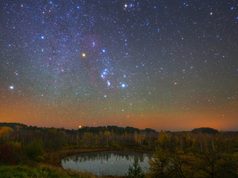















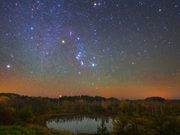































Spring in the northern hemisphere is a great time for stargazing. The spring night sky is sometimes called the “quieter sky,” because after the magnificent displays of the cold season, there are fewer bright stars than we saw in the winter. However, most of the winter stars are still going to be visible in the west after sunset. So, do take this last opportunity to look at the stars of Orion and the rest of the winter hexagon and the stars that have been dominating our night skies over the last few months. This will be the last chance for these until the early hours of the autumnal mornings.
The planet Jupiter is still unmistakable in the constellation Gemini in the spring night sky and is best seen in the southern or western sky depending on what time you are observing. Once the sky darkens in early April, if you look straight up through your aircraft’s eyebrow windows, you will see Jupiter overhead.
Jupiter is very bright, and even a small pair of binoculars will clearly show it to be a disc rather than a point of light. As the biggest planet in our solar system—at over 80 times the size of Earth—it is very easy to see. It is currently in the constellation Gemini, the twins. Incidentally, Jupiter has been going backwards in the sky (from east to west) for some time now, due to the phenomenon known as “retrograde motion.” Over a thousand years ago, this caused ancient astronomers some grief as they struggled to understand how this could occur. Jupiter has regained positive, or direct motion, after March 13 so all is well again in the cosmos! Look closely and you will note that Jupiter is again closing in on the twin stars of Gemini—Castor and Pollux. Once the sky darkens in early April, if you look straight up through your aircraft’s eyebrow windows, you will see Jupiter overhead with Castor and Pollux below to the right.
For more of a challenge, try to spot Venus. Following its conjunction with the Sun back in January, Venus may just be glimpsed in the evening sky very low on the western horizon, but only in a very light sky. It sets not long after sunset. Venus will slowly draw away from the Sun but at a very low angle so it will be difficult to see. It sets just over an hour after sunset in early April, but about two hours after sunset by the end of the month. However, by the time we get to May and June, Venus and Jupiter will both be visible in a darker sky very close to each other. The distance will be just over a full-moon angular diameter.





Looking at the stars, waiting until mid-April onwards, the Milky Way will be easily seen from any dark location. It stretches across the sky from the northern to southern horizons. This is one of the best times of the year to see the Milky Way as the longer hours of the spring skies—compared with summer’s—gives us longer to look at all the stars of the Milky Way. Incidentally, it’s useful to be reminded that apart from a handful of galaxies (M31, M33, and the two Magellanic Clouds specifically) everything we see in the sky is in the Milky Way.
Despite the high altitude at which most aircraft fly, the stars always twinkle; or to use the correct astronomical term “scintillate,” However, planets like Jupiter shine with a steady glow. It all comes down to atmospheric refraction. Stars are so far away that despite their brightness, they are only single points of light. But planets despite being “starlike” in their appearance, are small discs and so their reflected sun light does not twinkle. Some time ago, I was talking to a NASA Shuttle astronaut, and they commented about seeing the stars shining steadily from orbit. They remarked that it was beautiful but a little disconcerting.
Along with Jupiter, the bright winter stars are now slowly setting into the western sky, and the spring constellations of Leo and Virgo are now visible in the southern and eastern sky. A quick glance will show far fewer bright stars compared to the profusion of bright stars in winter. The only stars in the top 30 of brightest stars seen in spring, are Regulus in Leo, Spica in Virgo and Arcturus in Bootes. Regulus and Spica sit almost exactly upon Ecliptic and consequently can be occulted by the Moon, or rarely by a planet. The Big dipper is standing on its tail in April as it rotates around the northern celestial pole and Polaris. If you follow the handle of this asterism down towards the eastern sky, you will come to Arcturus, the fourth brightest star in the night sky
The Lyrids meteor shower will be seen around April 22, in the northeastern sky. With a new Moon on April 17, this means we will have moonless skies offering a good chance we will see some bright, fast meteors in the night skies.
I’ll be back with more as we welcome summer. Meanwhile, enjoy our dark skies and happy stargazing from the flight deck and from your own backyard.