













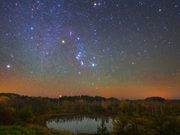





































Most astronomers look at the night sky on a seasonal basis, and we tend to identify certain groups of stars or constellations depending on what is visible at about 2200 hours at that time of year. But as we head into the fall in the northern hemisphere, many stargazing flight crew will have noticed how the night sky changes quite dramatically through the fall evenings.
In fall, in the early evening, the sky can be described as quiet. While it does darken earlier, there do not appear to be many bright stars in the night sky. The three stars of the summer triangle are still visible in the early evening, but they disappear quite quickly into the western dusk skies. This leaves us with the notably fainter fall constellations. However, if you are flying throughout the evening, it will immediately become apparent that as we turn our attention towards the eastern night sky, a good many very bright stars start to appear.
The skies darken earlier each night as the Sun heads south until the December solstice which in 2026 occurs at exactly 1550 EST on Monday, December 21 when it is over the Tropic of Capricorn. This gives rise to the popular misconception that the bright stars of winter are more prolific because it is winter. This does not apply if you venture into the southern hemisphere where the same stars will be visible in their summer.
All this has to do with the Earth’s annual passage around the Sun, and thus we see a different sky based on the location of the Earth at a particular time of the year. So, in the northern hemisphere in the fall, if you observe the night sky at 2200 hours, you will see the faint fall (spring in the southern hemisphere) constellations of Andromeda (The Princess), Pegasus (The Winged Horse) and Pisces (The Fish). However, if you look at around 0400 hours, you will see the bright stars of Orion (The Hunter), Taurus (The Bull), Gemini (The Twins) and Canis Major (The Big Dog) which includes the brightest star in the night sky Sirius, also known as The Dog Star, the brightest star in the constellation of The Big Dog.





Many casual observers do not realise that the stars and the various celestial objects move quite appreciably in our skies, and there is a distinctly seasonal nature to the sky. This movement occurs because the Earth turns daily on its axis and also orbits around the Sun. The “Sidereal” day is the time it takes to return to the same position relative to the stars (marked as “B” on the diagram below). The “Solar day” is the time the Earth turns precisely once on its axis in relation to the Sun and returns to the same position facing the Sun (marked as “C” on the diagram).

Solar and Sidereal days
As well as rotating on its axis, the Earth also orbits the Sun, and in 24 hours it will move approximately 1/365th of its orbit around the Sun. The consequence of this difference is that the stars appear to rise 3 minutes and 55.6 seconds earlier each day.
It is straightforward to prove this for yourself. On a clear night, look in a southerly direction and identify a bright star and time exactly when it is due south on your personal or aircraft’s compass. The following night, look for the same star about five minutes earlier. Look at the same star and you will notice that it will be in precisely the same spot a fraction under 5 minutes earlier. The arrival at this position is actually 4 minutes and 56 seconds earlier each day (known as the sidereal day) and is simply due to the Earth rotating on its axis in 24 hours (the solar day) while also moving 1/365th per day on its orbit around the Sun. If you look for the same feature in the sky over a few days or weeks, you will quickly notice that the sky clearly moves from east to west.
The same motion can also be seen in the northern sky as the Big Dipper moves around the Pole Star on an annual basis. The Pole star, or Polaris, is always due north and is the same height above your horizon as your latitude. (If you are looking from your aircraft in the southern hemisphere, of course Polaris will never rise above your horizon. Sorry!)

If we take a list of the thirty brightest stars in the night sky and classify them as fall, Winter, Spring and Summer, and we will also add to this list those stars which are exclusively visible in the southern hemisphere the following facts emerge:
1 bright star visible in fall
12 bright stars visible in winter
4 bright stars visible in spring
4 bright stars visible in summer
9 bright stars only visible in southern skies
This is why, from a northern-centric perspective, we tend to believe the brightest stars are visible in our winter months. It all has to do with the position of the Earth as it orbits the Sun.