





















































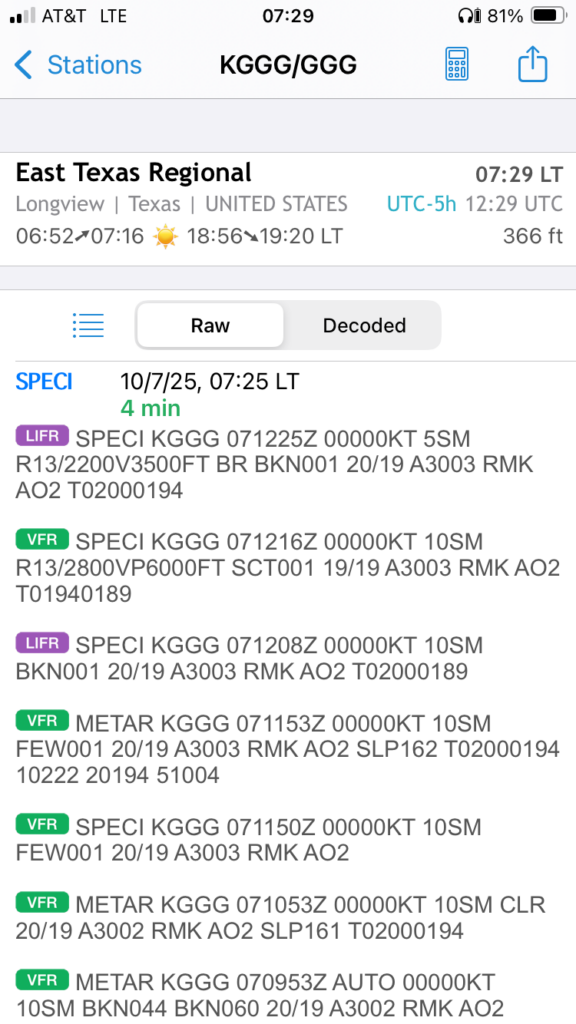
SPECI KGGG 071225Z 00000KT 5SM R13/2200V3500FT BR BKN001 20/19 A3003 RMK A02 T02000194
SPECI KGGG 071216Z 00000KT 10SM R13/2800VP6000FT SCT001 19/19 A3003 RMK A02 T01940189
Above, I’ve listed two METARs at my home airport (East Texas Regional Airport, KGGG) in Longview, Texas. Notice the difference between the visibility in each and the runway visual range (RVR) readout for runway 13. On the 1216Z observation, visibility is ten statue miles, while the RVR is 2,800 feet (about 0.5 statue mile) varying to over 6,000 feet (one+ statue mile). Even with the low RVR reading, there is no explanation as to why—no mention of fog, mist, smoke, or anything else.
Nine minutes later, in the 1225Z observation, visibility is five statue miles, but the RVR is 2,200 feet (less than ½ statue mile) varying to 3,500 feet (about 0.66 statue mile). This time, it does say the visibility is restricted due to mist (BR).





At first glance, you might think there is something wrong with these METARs. However, they are not automated (there is no AUTO at the beginning), and they are clearly listed as SPECIs meaning they are “special” or non-routine observations. I know exactly why these METARs say this, because I was out on a morning run watching this unfold on the runway.
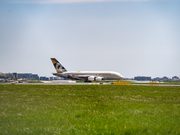
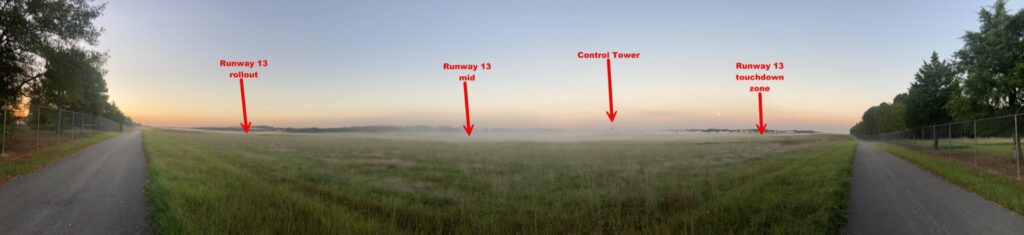
Side note: I’m a runner and have the absolute best place to run – the airport perimeter road which is a “non-movement area” where I can run over ten miles with my airport security badge. This running spot lets me observe weather coming through the airport and sometimes get to witness this interesting discrepancy between the prevailing visibility and the surface visibility on the runway itself. Here is a photo I took on the day these METARs were observed:
Looking at the FAA’s Aviation Weather Handbook (FAA-H-8083-28), chapter 24 explains that prevailing visibility is “… the greatest distance that can be seen throughout at least half the horizon circle, not necessarily continuous.” Runway visual range, on the other hand, is reported when “… prevailing visibility is 1SM or less, and/or the RVR for the designated instrument runway is 6,000 ft. or less.” The RVR is “… the horizontal distance a pilot may see down the runway.”
Now, check out the previous photo. You can see the prevailing visibility is excellent! You can see trees across the airport and hangars in the distance. But, right in the area over runway 13, there is a low-lying area that has mist forming. The mist is centered right over the one RVR transmissometer for runway 13. Since the prevailing visibility includes the greatest distance seen through at least half the horizon circle, and generally visibility is ten statue miles in the picture, that’s why the weather observer coded it that way. But, since the RVR was so much lower than prevailing visibility, that needed to be added to the METAR as well.
Two more fun METAR facts to wrap up.
SPECI KGGG 071216Z 00000KT 10SM R13/2800VP6000FT SCT001 19/19 A3003 RMK A02 T01940189
Obviously 19 is the temperature and 19 is the dewpoint in Celsius (C). T01940189 decodes as temperature 19.4 degrees C and dewpoint 18.9 degrees C. The spread is only 0.5 degrees C, and then in the next METAR, it’s only 0.6 degrees C. This is clearly why the patchy area of mist is showing up over the runway in this lower area of the airport – the air temperature just above the ground has almost matched the dewpoint, and the amount of moisture in the air has appeared as water vapor (mist).
SPECI KGGG 071225Z 00000KT 5SM R13/2200V3500FT BR BKN001 20/19 A3003 RMK A02 T02000194
SPECI KGGG 071216Z 00000KT 10SM R13/2800VP6000FT SCT001 19/19 A3003 RMK A02 T01940189
Second fun fact: why does the METAR reporting ten statue miles visibility not mention mist or fog or any reason for the RVR to be so low? Referring to the FAA’s Aviation Weather Handbook, chapter 24 explains the reason for a visibility restriction is not coded unless prevailing visibility is less than seven statue miles. There are only a few exceptions to this rule, notably that volcanic ash is always reported. But in this case, the METAR with five statue miles needed a reason (BR) for the visibility obscuration to be coded, and the one with ten statue miles did not require the observer to code the reason.
For a video I made about this exact scenario, find it on YouTube! https://youtu.be/1IT433Ht_iM or scan this code: