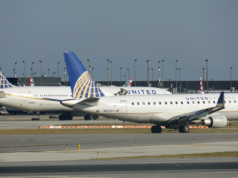
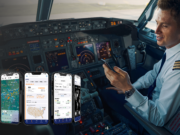




































Another circuit around the sun has occurred since we published an article about the history and issues regarding cell phones on airliners. (See Grey Matter, May 2025.) Based on an actual, recent event, we thought you might be interested in a part two of Phones on Planes: Worse Than Snakes on Planes…
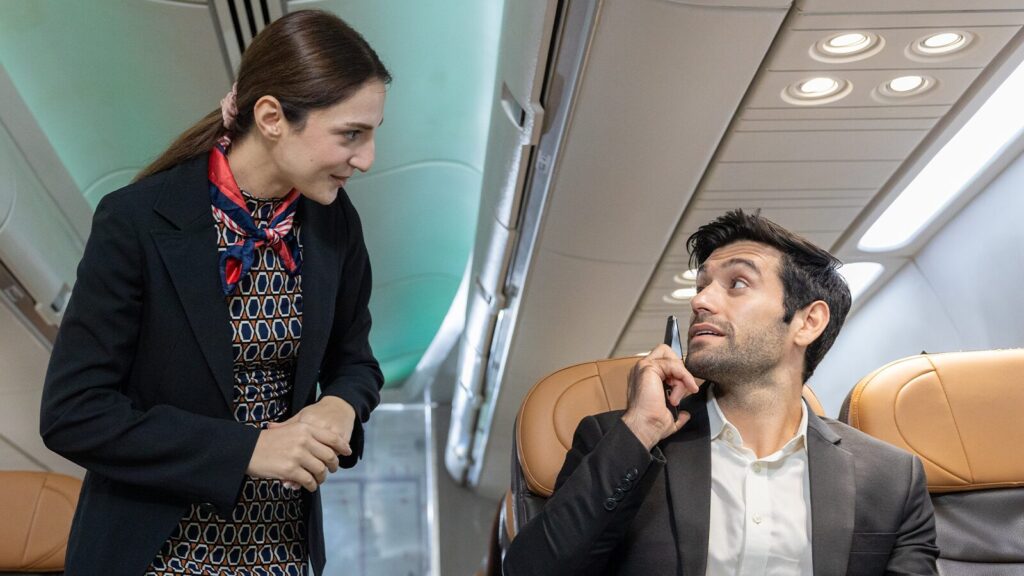
I was operating to Paris a few weeks ago out of Newark, and shortly after takeoff the lead flight attendant (FA) rang the flight deck to report a passenger who was refusing to end a phone call. I was of course immediately surprised because our airborne WiFi is so bad you can barely send a text or email, much less carry on an actual phone call; yet I quickly moved to the issue at hand, which was not the call itself (we’ll get to that in a moment), but the act of non-compliance. The FA had asked the passenger to stop, but the passenger did not. Further, the FA reported that the passenger not only repeatedly refused to end the call but also demanded proof that the call was “illegal,” additionally requesting that the flight’s captain deliver this information personally. I really wonder sometimes if people just seek out conflict for conflict’s sake. As I pondered this, the FA was waiting on the other end for a response from the flight deck.
And here it is:
First, pilots do not leave the flight deck once airborne to address passengers’ concerns or demands—this is what the PA system and law enforcement are for.




Second, refusing to comply with a crewmember’s instructions and interfering with their duties is a federal crime.
Third, neither this airline, nor the FAA and FCC have authorized in-flight phone calls; thus, having one while flying on an airliner remains a violation of federal law.
Continued refusal to comply will result in law enforcement meeting the aircraft upon landing—either in Paris or in Newark should we have to go back.
Do not make me turn this plane around.
FAs are typically very good at deescalating conflict, and although this was an unusual event, they were ultimately successful at resolving it, and we landed in Paris about six hours later without any further issues. However, the lead FA did follow-up and ask if there were, in fact, specific regulations that cover points two and three above. I said indeed there are, and I wrote them out just in case she ever has a non-compliant jerk of a passenger demand to know what laws they’re breaking. And now, I’ll write them out for you here, starting with the set that could land one in federal prison for up to 20-years:
Title 14 Code of Federal Regulations (CFR) Federal Aviation Regulation (FAR) Part 121.580, FAR Part 91.11, and Title 49 United States Code (USC) 46504 all state that it is a federal crime to assault, threaten, intimidate, and interfere with flight crew duties, as well as hinder, disrupt, or fail to follow crewmembers’ instructions.
Example:
FA: “Please discontinue your call and turn your phone off.”
Passenger: “No.”
Please standby to explain your response to the police because this is interfering with the duties of a flight crewmember and blatant non-compliance.
A side note about non-compliance while we’re here: the industry considers a passenger’s refusal to comply with crewmember instructions (regardless of how minor the infraction or inconvenience the passenger thinks it is) as a potential threat to the safe operation of the flight. If you refuse to turn your phone off or take your seat and buckle your seat belt, what other rules might you decide do not apply to you? So, flight crew care about these things, and so do cops, the Federal Aviation Administration (FAA), the U.S. Department of Transportation (DOT), and potentially North American Aerospace Defense Command (NORAD), along with the White House.
Returning to the title of this article though and with specific regard to the regulations impeding your ability to make phone calls while on an airliner in flight, these are:
Federal Communications Commission (FCC) Title 47 CFR 22.925 as well as Part 22 of the Commission’s Rules, in addition to Title 49 USC 41725 (The FAA Reauthorization Act, 2018), and FAR Title 14 Part 91.21.
Here’s a snapshot of this regulatory language:
- The Secretary of Transportation shall issue regulations to prohibit an individual on an aircraft from engaging in voice communications using a mobile communications device during a flight of that aircraft in scheduled passenger interstate or intrastate air transportation.
- Further: Cellular telephones installed in or carried aboard airplanes must not be operated while such aircraft are airborne.
- And: No person may operate, nor may any operator or pilot in command of an aircraft allow the operation of, any portable electronic device on an aircraft operated by a holder of an air carrier operating certificate.
There. Presently, it remains illegal. Full stop.
Although we covered this last year, it is worth restating here: a switched-on cell phone or a cabin full of switched-on cell phones will not bring down an airliner. However, having them turned off does prevent significant disruption to safety briefings and demonstrations along with the massive potential for air rage and in-cabin conflict—the problematic magnitude of which cannot be overstated.
Planes are one of the last few places where you can escape the blare, bleep, and bother of everyone incessantly engaging with their phones—and I hope, in the skies at least, we are able to keep it that way.
So, if you don’t have the right to talk on your phone or ignore flight crewmember instructions, what rights do you have on airliners? Well, we’ll address the Airline Passenger’s Bill of Rights next month and talk about that.
Thanks for reading—and for not talking on your phone in flight.