


























































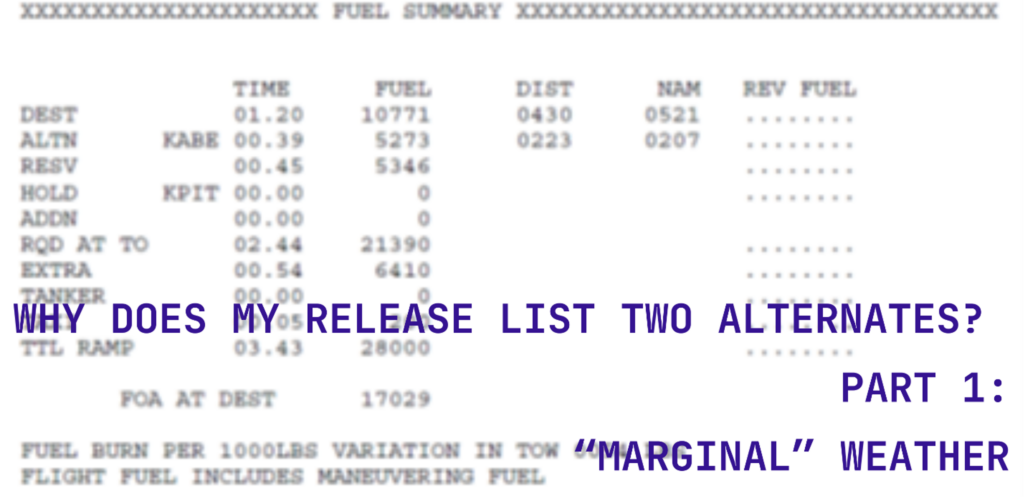
When your dispatch release has two alternates listed rather than just one (or none), you might wonder why. There are two scenarios where you are legally required to have a second alternate, outside of ETOPS rules. I’ll explain one here and the other in next month’s article.
Scenario 1: “Marginal” Weather: 14 CFR § 121.619(a)
This is one of those confounding regulations that is difficult because of what the FAA did not define. You might read this regulation and see the “1-2-3 rule” for domestic operations. At first glance it seems a lot like Part 91 instrument flight rules. However, there’s a requirement for an additional alternate to be added if “the weather conditions forecast for the destination and first alternate airport are marginal…” (14 CFR § 121.619(a)). What is “marginal?” Spoiler: the FAA never defines “marginal” within 14 CFR.
I did some digging around in the FAA’s Legal Interpretations database (so you don’t have to!) and found an interpretation from 1989 where the FAA was asked about the definition of “marginal.” To quote from their response, “we cannot give a definitive answer to your question.” This fantastic non-answer is found on page 7 of the linked PDF to read in context. https://drs.faa.gov/browse/excelExternalWindow/FAA000000000LEGALINTPR2007004PDF.0001 Or, to skip all the background and legalese, here’s a screenshot from interpretation 1989-28 which the FAA had attached to another interpretation from 2007.


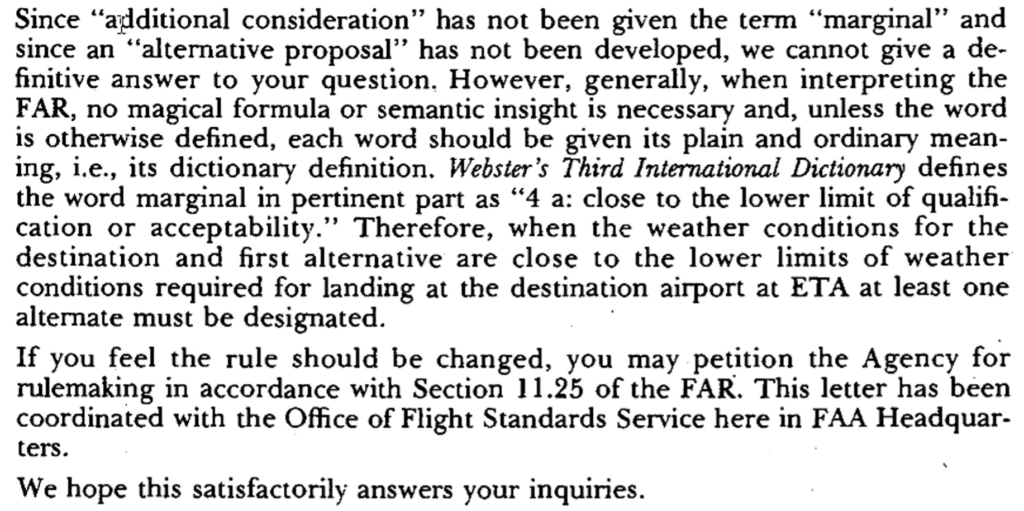
This does not satisfactorily answer my inquiry. What does “weather conditions…close to the lower limits of weather conditions…” mean? What is “close” in this context?
The bottom line is this: the FAA has never defined “marginal” related to weather. It has been left up to each certificate holder (read: airline) to determine what “marginal” means to them. Because of this, it’s important to be able to reference what your operation calls “marginal.”
Some operators use a time-based window, and others just look at the estimated time of arrival. Each airline is responsible to get its own definition of “marginal” that their certificate management office can agree upon. Essentially, it takes the regulation and makes it dependent on the airline’s definition of “marginal” meaning there is great variety among airlines on what is “marginal.”
Here are three examples from three different real airlines operating under domestic rules. (Names have been changed to protect the innocent.)
Airline A says two alternates are needed if both these conditions are met:
- Marginal at destination airport: < 1000′ ceiling OR < 3sm visibility from 1 hour before to 1 hour after ETA AND
- Marginal at first alternate: < 600′ ceiling OR < 2sm visibility at the ETA
Airline B says two alternates are needed if both these conditions are met at the ETA:
- Marginal at destination airport: forecast at lowest authorized landing minimums AND
- Marginal at first alternate: forecast is at lowest authorized alternate filing minimums
Airline C says two alternates are needed if both these conditions are met at the ETA:
- Marginal at the destination: less than 600’ ceiling and less than 2sm visibility AND
- Marginal at the first alternate: less than 600’ ceiling and less than 2sm visibility
This gets confusing if you are used to one set of rules at one airline and then encounter a new set of rules at your next airline because there’s no standardization required. My advice: if your dispatcher adds a second alternate on the release, and you have any concerns about why, ask the dispatcher for clarification. It could be for “marginal” weather. But it could be for the second reason, which I’ll discuss in next month’s release from Desk One!