


















































Pilots are trained to use all available resources when abnormal situations arise, such as emergencies. During airport operations, a critical safety role is delegated to Aircraft Rescue and Firefighting (ARFF). These professionals undergo extensive training to handle a multitude of events and to promptly respond to any aircraft emergency.
Each aircraft incident requires a variety of emergency solutions. Airport firefighters undergo extensive training in the application of firefighting foams, dry chemicals, and clean agents to extinguish burning aviation fuel. To the extent possible, they control the spread of fire in order to maintain a safe evacuation path for passengers exiting the hazard area. Under Part 139, the FAA mandates ARFF presence at all airports served by air carriers. ARFF facilities are inspected annually for compliance with mandated regulatory standards.
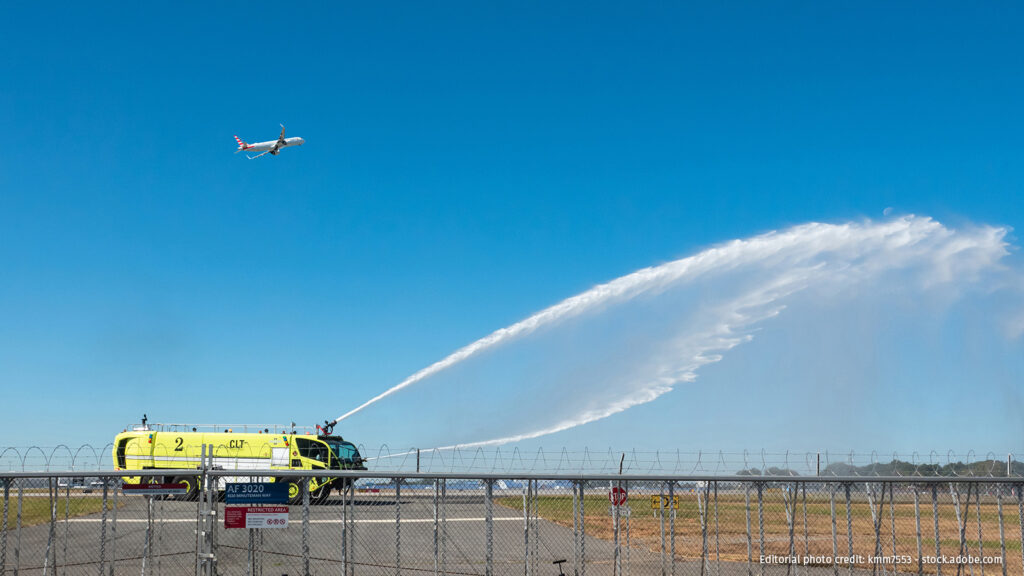
Depending on the type and length of aircraft an airport serves, different requirements, known as “indexes,” are mandated. An index determines the number of ARFF vehicles and the quantity of extinguishing agents required. Visually, these vehicles differ from traditional municipal fire trucks. They are larger, allowing them to carry additional water, equipment, gear, and up to five personnel. They are also designed for off-road operations, with wide tires and long-travel suspension systems, as they may need to maneuver through aircraft parts and debris. Each vehicle is equipped with powerful, high-capacity pumps capable of spraying water and foam over long distances from turrets.
A variety of extinguishing agents is available to ARFF personnel, ranging from dry chemicals and water to firefighting foams. Personnel are required to train in real-world scenarios on an annual basis. In addition, advances in technology have enabled virtual-reality training, allowing ARFF teams to simulate real-life situations and gain experience handling a wide variety of scenarios without the cost and safety concerns associated with live vehicle operations or live-fire training.





It is important to emphasize the role of communication between pilots, air traffic control, and ARFF personnel. Clear and concise exchanges allow pilots to make informed decisions pertaining to the safety of passengers and crew. When an emergency evacuation is initiated by the captain, it is imperative, to the extent possible, to communicate this to ATC and ARFF personnel. Previous accidents have demonstrated that uncontrolled evacuations can result in injuries unrelated to the aircraft damage itself, including instances where ARFF vehicles have struck passengers. When communicating with ARFF personnel, pilots should be specific when asking questions and when instructing ARFF crews to be additional sets of eyes outside the aircraft.
Per FAR Part 139, the first responding ARFF vehicle must reach the midpoint of the farthest runway, or any point on the movement area, and begin discharging extinguishing agent within three minutes of the alarm. In other situations, such as when an emergency landing is anticipated, ARFF vehicles are strategically pre-positioned at multiple runway intersections, allowing them to enter the runway within seconds of the aircraft touchdown. Drill exercises are conducted regularly to ensure Part 139 standards are consistently met.
ARFF professionals often work behind the scenes at airports across the nation, rarely drawing attention during routine operations. Yet within the layered system of aviation safety, ARFF serves as one of the final lines of defense when accidents occur, playing a critical role in preserving lives and keeping the traveling public safe.