




















































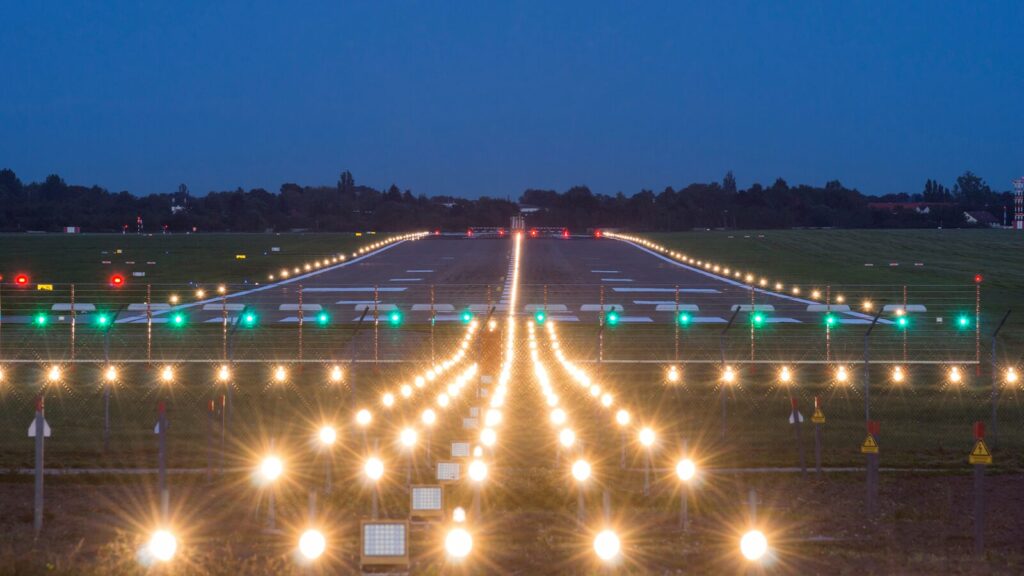
Runway Safety Lights (RWSLs) are systems installed across 20 airports within the United States designed to avoid runway incursions, prevent collisions, and the loss of aircraft separation. Such lights, red in color, are embedded within the pavement of taxiways and runways. Development on RWSL began as early as 1992 by MIT’s Lincoln Laboratory. History has shown, through events such as the Tenerife accident, the importance of developing systems to prevent runway accidents involving aircraft collisions. After proceeding with installation of over 170 lights in the real-world environment and collecting data across 8,298 aircraft operations, the FAA determined it was successful in meeting its objectives.
RWSLs are fully automated and independent from air traffic controller input. Pilots are aware of their existence through two main components: Runway Entrance Lights (RELs) and Takeoff Hold Lights (THLs). The first system intends to prevent inadvertent aircraft entry onto a runway from an intersecting taxiway. The second system aims to mitigate the initiation of the takeoff roll due to unsafe runway conditions, such as the presence of another aircraft or vehicle on the runway. Both systems play critical roles as parts of an ongoing effort to improve situational awareness and reduce the number of runway incursions and accidents, without interfering with airport operations.
Runway Entrance Lights (RELs) are an array of red lights focused along the taxiway centerline at the hold-short area. When illuminated, pilots should remain clear of the runway, due to another departing or arriving aircraft. When traffic departing reaches 30 knots, the lights illuminate. For arriving traffic, they illuminate when traffic is approximately one mile from the runway threshold. Lights then extinguish at each equipped taxiway approximately two to three seconds before the aircraft reaches it. Once the landing aircraft reaches 34 knots, all lights extinguish. If a pilot receives an ATC clearance contradicting the system, it is imperative to remain stopped and to contact ATC for resolution.
Takeoff Hold Lights are also red in color, but unlike RELs, they are a longitudinal row of lights aligned parallel to the runway centerline lights. Activation indicates to remain holding in position and not to start the takeoff roll. They automatically illuminate when two aircraft, or an aircraft and a surface vehicle, are present on the runway. When only one remains, the lights extinguish. Similar to RELs, query ATC immediately if a clearance for takeoff is received with the lights active. In the event they illuminate during the roll, proceed with the best possible judgement. Aborting the takeoff sequence may be the best course of action, if still practical for safety reasons.



During proof-of-concept, the RWSL achieved over 98% agreement with ATC-issued instructions. Accuracy of Runway Safety Lights is extremely high due to two primary reasons. First, it feeds from ASDE-X, a surveillance system using radar and satellite technology to track surface movement of aircraft. ASDE-X has a positional accuracy of at least 20 feet and has been paramount in improving safety over the years. Second, RELs are fully autonomous. As such, it keeps the system standardized for all users and has the potential to prevent a controller or pilot error. The only component controllers are able to adjust is the brightness level of the lights (five different levels), to accommodate for environmental conditions. Controllers can also turn the system off, in the event of a malfunction or anomaly, and a NOTAM would be issued accordingly. Pilots are reminded to always ensure their transponder is “ON”, with attitude reporting, while operating on all taxiways and runways, to ensure the system interacts as intended with ASDE-X.
In summary, safety lights are another layer of redundancy in aviation safety, making it critical for pilots to understand their significance in preventing a runway-related accident. Their fully automated design offers protection against human error. Yet, it is important to emphasize they serve as a warning by indicating a runway status and do not substitute an ATC clearance.