










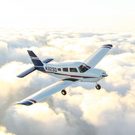










































Multi-engine airplanes are generally capable of carrying heavier loads than single-engine aircraft, as well as flying faster and higher. However, they also present additional challenges to pilots, making it essential to remain proficient in emergency procedures and to understand how to respond in the event of an engine failure.
One ground-handling advantage of multi-engine airplanes over single-engine aircraft is their ability to use differential power. Turning with the assistance of differential power reduces the need to apply brakes during ground turns. Operating a multi-engine airplane with one engine inoperative results in significant penalties in both performance and control. From a performance standpoint, a loss of 50 percent of power results in a disproportionate loss of climb capability, while directional control is greatly affected by the asymmetrical thrust being produced.
After liftoff, gaining altitude should take priority over increasing airspeed. Experience has shown that trading excess speed for altitude after an engine failure is a complex and often ineffective maneuver. Altitude gives the pilot valuable time to think and react. Additionally, if an engine fails shortly after takeoff and runway remains available, it is preferable to abort the takeoff rather than continue the climb, provided the landing gear has not yet been retracted. For safety, the airplane should never rotate before reaching and exceeding the published Vmc (minimum controllable airspeed). An engine failure during climb at a speed below Vmc will result in the immediate loss of directional control. Pilots should always use the rotation or liftoff speeds recommended by the aircraft manufacturer; if no specific value is published, adding five knots to Vmc is recommended.
Unlike single-engine airplanes, multi-engine aircraft are more susceptible to turning tendencies. To counteract these tendencies, many designs use counter-rotating propellers, where the propellers spin in opposite directions. This cancels out the turning forces, reducing the amount of rudder required to maintain control.



Consider a left engine failure. The airplane will immediately yaw to the left due to asymmetrical thrust. The yaw causes the right wing to travel faster than the left, creating a rolling movement toward the inoperative engine. Additionally, increased induced flow over the right wing, combined with reduced lift over the left wing, results in a roll toward the failed engine.
Another key concept is Vmc, the minimum controllable speed with one engine inoperative. As airspeed decreases, rudder effectiveness diminishes, requiring greater rudder inputs to maintain directional control. Below a certain speed, further decreases lead to a loss of directional control. Vmc addresses control, not performance. Certification of Vmc typically considers the most unfavorable weight, which is not necessarily the maximum takeoff weight, the most aft center of gravity, and specific aircraft configurations and power settings.
Pilots should be able to recognize the signs of an impending Vmc loss of control, which include yawing and loss of directional control, stall buffet or warning horn activation, and decreasing rudder effectiveness. To recover from a Vmc loss of control, reduce power on the operative engine to idle to lessen asymmetrical thrust, then lower the nose to increase airspeed and restore control effectiveness.
Several factors affect Vmc, including aircraft configuration, weight, center of gravity, density altitude, and power setting. As a pilot, a lower Vmc is generally desirable, as it provides more controllability at lower speeds. Banking two to three degrees toward the operative engine typically results in a zero-sideslip condition, where the relative wind is perpendicular to the aircraft’s longitudinal axis. This minimizes Vmc and improves performance. Conversely, maintaining zero bank, using only rudder to hold heading, leads to a higher Vmc and lower performance, due to the large rudder deflections required. This reduces the rudder’s effective angle of attack, making it less effective at countering asymmetric thrust.
It is essential to understand the aerodynamics of single-engine operations when transitioning to multi-engine aircraft. While the advantages of having an additional engine, such as higher cruise speeds and greater payload, are clear, pilots must also be prepared for engine failure scenarios and the aerodynamic principles behind them. A thorough understanding of these concepts is critical to ensuring the safe operation of multi-engine airplanes.