

















































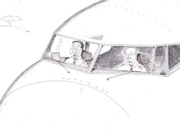







Regular readers of our Grey Matter column may recall the December 2023 article, The Actual Tragedy of Flight 2059, where we wrote about a nearly catastrophic event for a Horizon Air flight on October 22, 2023; and the actual, as well as figurative, catastrophe of Captain Joseph Emerson’s mental state and the difficulty he, and other pilots, faced in seeking mental health treatment within the draconian confines of FAA certification. Since that event, Joseph Emerson (no longer a pilot, and in fact, not allowed within 25 feet of any airplane) pled guilty and no contest to the associated charges, fully acknowledged his responsibility as well as the mental health challenges that led him to that fateful flight. Further and pursuant to a Oregon state plea agreement in September, he will spend the next five years on probation, is compelled to complete 664 hours of community service, and pay $60,000 in restitution. He is still facing federal sentencing on November 17, which will likely involve prison time.
So, what has the FAA done in the two years since this watershed event? By June 2024, the FAA had decided to reduce its immediate involvement in 11 conditions (mostly “anxiety” based and some transient depressive episodes) for which an Aeromedical Examiner (AME) could issue medical certification without having to send the pilot’s records to the FAA Aeromedical Certification Division for review and approval. They also indicated that aviators diagnosed with depression could take one (and only one) of four approved SSRIs, one of three SNRIs, one NDRI, or one SSRI 5-HT1A RPA in hopes of potentially being re-certified to fly after about six months—although anyone familiar with the special issuance process will know that this is like the small print at the bottom of an exercise program or weight loss ad that says, “Results not typical.” (And good on you for looking up the drug types to understand what they are and why these medications are important—and complicated.)
To be clear though, this does mean that there exists the potential for a pilot to be openly treated, but they will likely be in an un-paid status for the duration of the special issuance medical-certification process. Although this certainly represents progress for mental health treatment and the agency, it’s probably a step best characterized by Capt. Dennis Tajer, a spokesman for the Allied Pilots Association, who stated that, “FAA was kind of stuck in the 1970s—they’ve lunged themselves into maybe the ’90s, and I’m being generous.”
Fast forward to September of this year and the bipartisan Mental Health in Aviation Act (MHAA) is pending review in the Senate after passing the House. The MHAA is a result of the Mental Health Aviation Rulemaking Committee’s consensus recommendations aimed at reducing the stigma associated with mental health in the aviation industry, improving access to mental health care, enhancing the special issuance process, all in an effort to advance aviation safety by ensuring pilots and air traffic controllers are mentally as well as physically healthy.





The overarching tenants of this bill include:
- Requiring the FAA to review and update its regulations and policies on mental health for aviation professionals
- Establishing a task force to develop recommendations for improving mental health care in the aviation industry
- Providing funding for training and support for AMEs who specialize in mental health
- Requiring the FAA to report annually on its progress in implementing the MHAA’s provisions
Although Air Line Pilots Association (ALPA) President Capt. Jason Ambrosi, rightly stated that the MHAA “…represents a crucial step forward to improving aviation safety and maintaining a healthy work environment for pilots,” the reality is that there is still a long way to go in process and practice which is subtly captured in a final bullet point for the bill:
- Encourage pilots and air traffic controllers to disclose mental health conditions and seek treatment without fear of job loss.
The very fact that this has to be included speaks volumes. There remains (and likely will even if the MHAA is ultimately signed into law) a significant number of barriers for pilots and air traffic controllers to overcome to secure mental health assistance, the most significant of which is encapsulated in this point above—trust.
Good luck finding a single pilot at any airline who believes that if they disclose having anxiety, depression, or express the need for counseling to their AME (and by extension the FAA’s Aeromedical Certification Division), that they will not significantly risk losing their medical certificate and spend years—unpaid and unable to work as a pilot—struggling to get it back in a genuine effort to improve their mental health. This is not an industry that is imbued with trust in their regulator for professional conditions, much less personal ones; something that in my view is an environment and sentiment fostered by the agency itself. The industry quip regarding the FAA, “We’re not happy until you’re not happy,” rather says it all.
Should aviators and controllers be physically and mentally healthy to execute safely on the mission of a critical public-trust endeavor? Absolutely. Should the pathway to disclosure, acceptance, and effective treatment be trustworthy and vigorous as well? Absolutely.
We’ll check in again on this topic as the MHAA advances through the legislative process and see where we all land.
Before closing though, Joseph Emerson and his wife have started a nonprofit, Clear Skies Ahead, aimed at improving pilot health and wellness. Check it out: https://www.clearskiesaheadnonprofit.org/